
Device Certificate Security: The Missing Link in Data Center Cyber Resilience
Published on July 21, 2026,
by

Data center security conversations often focus on firewalls, network segmentation, access controls, and identity management. While these controls remain critical, many organizations overlook a growing vulnerability hidden within their infrastructure, the intelligent devices that power and monitor modern data centers.
Power Distribution Units (PDUs), sensors, intelligent rack controllers, environmental monitoring systems, and edge devices have evolved from simple operational components into network-connected endpoints. These devices now communicate across enterprise networks, authenticate users, exchange sensitive information, and play a critical role in maintaining uptime.
The challenge is that many organizations still manage these devices using manual processes, fragmented tools, and inconsistent security practices. As digital infrastructure expands and certificate lifecycles continue to shrink, traditional approaches are no longer sufficient.
This is where Device Certificate Security and Firmware Security have become essential disciplines for modern data center operations. To maintain operational trust and integrity, every connected device must prove its identity, encrypt communications, and run trusted firmware. When any of these elements fail, the consequences can range from service disruptions to serious cybersecurity incidents.
The Growing Risk Hidden in Modern Infrastructure
Data centers today now contain thousands of connected devices. Many organizations operate heterogeneous environments consisting of infrastructure from multiple manufacturers, each with different management interfaces, firmware requirements, and security procedures.
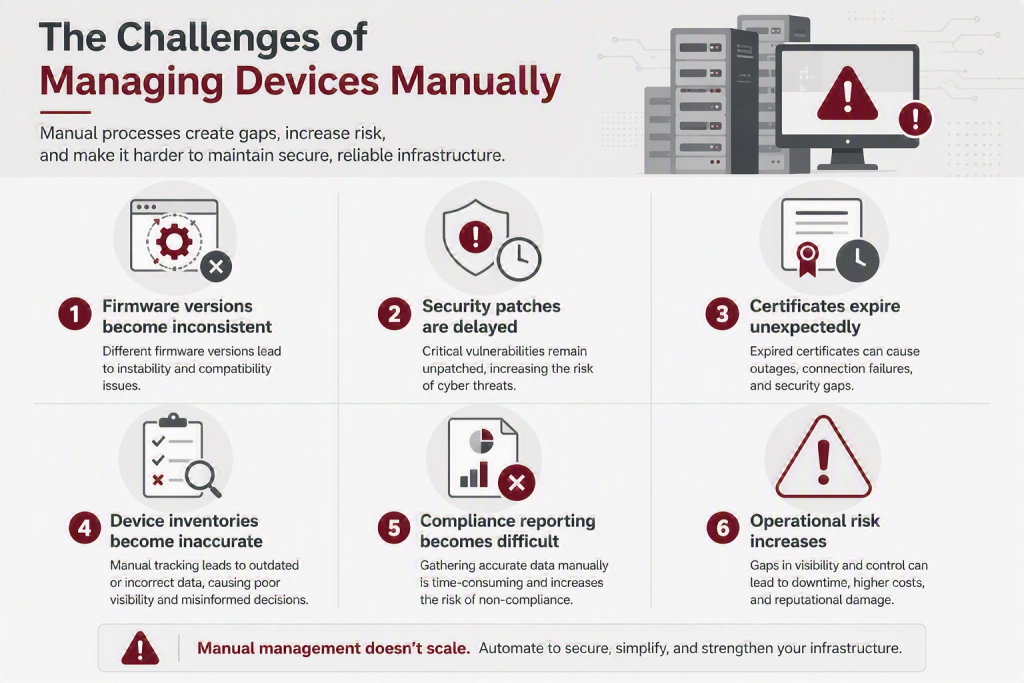
The problem becomes even more significant in edge and distributed environments where devices may be deployed across remote facilities with limited on-site support. As organizations continue expanding edge computing initiatives, the number of devices requiring ongoing security management continues to grow.
Without a centralized approach, infrastructure teams often resort to spreadsheets and manual tracking processes that simply cannot scale.
Why Device Certificates Matter More Than Ever
Digital certificates serve as the foundation of trust between connected devices and the systems they communicate with.
They help:
- Authenticate device identity
- Enable encrypted communications
- Prevent unauthorized access
- Support regulatory compliance
- Establish trusted infrastructure relationships
However, certificate management is becoming increasingly challenging.
Certificate lifetimes are rapidly shrinking, and security standards now require more frequent certificate updates. What was once managed on an annual basis may soon require significantly more frequent maintenance. Managing thousands of certificates manually creates an unacceptable operational burden while dramatically increasing the likelihood of outages caused by expired credentials.
When a certificate expires, devices may lose their ability to authenticate, communicate, or connect to critical systems. Authentication failures can quickly cascade into operational disruptions.
Automating Device Certificate and Firmware Security at Scale
While digital certificates establish trust, firmware provides the foundation for secure and reliable device operations. Both are essential to maintaining the integrity, availability, and security of today's data center infrastructure. However, managing certificate renewals and firmware updates across thousands of devices from multiple vendors can be complex, time-consuming, and difficult to scale.
Nlyte Device Management addresses this challenge by providing a centralized, vendor-agnostic platform that automates both certificate and firmware lifecycle management. As a result, organizations can eliminate manual processes, reduce operational overhead, and strengthen their overall security posture. Rather than managing devices individually, infrastructure teams gain centralized visibility and control across their entire device estate.
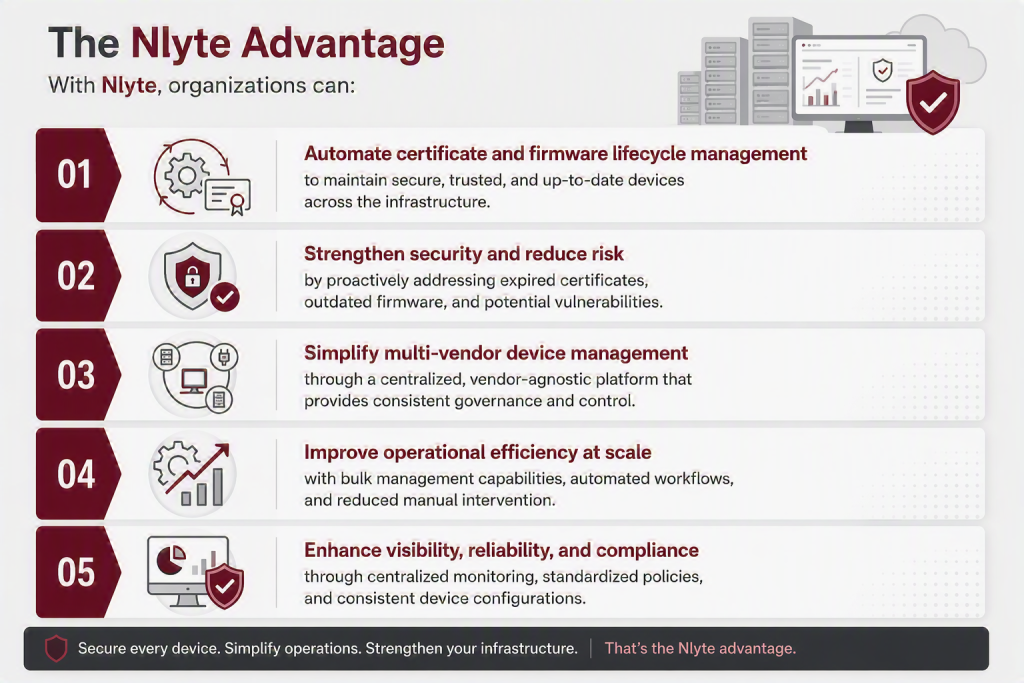
Furthermore, Nlyte simplifies the management of diverse device ecosystems by bringing certificate security, firmware governance, and device administration into a single platform. Through automated workflows and centralized control, teams can proactively identify security risks, apply updates at scale, and maintain trust across both data center and edge environments.
Supporting Zero Trust Infrastructure
Zero Trust has become a common cybersecurity strategy, but many organizations focus primarily on users, applications, and networks.
Infrastructure devices are frequently overlooked.
Zero Trust Infrastructure Security requires every device to continuously prove its identity, integrity, and compliance throughout its lifecycle. This means organizations must know:
- What devices exist
- Where devices are deployed
- Which certificates are active
- Which firmware versions are installed
- Which devices may present risk
By combining certificate governance with firmware visibility, organizations can establish a stronger security foundation that extends beyond traditional IT assets.
The result is improved trust, reduced operational risk, and greater confidence in critical infrastructure.
The Future of Infrastructure Security
As data centers become increasingly connected, distributed, and dependent on intelligent devices, infrastructure security must evolve beyond traditional approaches. Device certificates and firmware are fundamental to maintaining trust, security, and resilience across modern digital infrastructure. However, managing these critical security controls manually is becoming increasingly difficult as device volumes grow, certificate lifecycles shorten, and cyber threats continue to evolve.
Nlyte Device Management delivers lasting value by automating certificate and firmware lifecycle management, providing centralized visibility across multi-vendor environments, and simplifying security operations at scale, Nlyte helps organizations reduce risk, improve operational efficiency, and strengthen compliance readiness. As a result, infrastructure teams can move away from reactive maintenance and focus on strategic initiatives that support business growth and operational excellence.
Ultimately, the future of infrastructure security depends on ensuring that every connected device remains trusted, secure, and up to date. Organizations that embrace automation, centralized governance, and integrated device security will be better positioned to improve cyber resilience, protect critical services, and confidently support the demands of modern data center and edge environments.


Request a Demo Today