
MCP and LLMs: The Missing Link for Smarter Data Center Operations
Published on September 13, 2026,
by

As AI transforms every aspect of digital infrastructure, a new challenge is emerging. How do organizations enable Large Language Models (LLMs) to securely interact with the vast amount of operational data that exists across the modern data center? The answer may lie in an emerging open standard called Model Context Protocol (MCP), a technology increasingly viewed as a critical bridge between AI intelligence and enterprise infrastructure systems.
The Next Evolution of Data Center AI
AI workloads continue to drive unprecedented demand for compute capacity, while operators face mounting pressure to improve efficiency, reduce downtime, manage sustainability objectives, and optimize increasingly complex environments. Data Center operators are simultaneously managing rising costs, power constraints, capacity planning challenges, and growing AI infrastructure requirements.
At the same time, AI itself is becoming part of the operational toolkit. Organizations are exploring the use of machine learning, predictive analytics, and conversational AI to improve infrastructure management. However, one major obstacle remains: operational data is often fragmented across DCIM platforms, monitoring tools, IT systems, facilities applications, and business databases.
While LLMs such as GPT, Claude, Gemini, and others can reason over information remarkably well, they are only as effective as the data they can access. Without a secure and standardized way to interact with operational systems, even the most advanced AI models remain disconnected from the infrastructure they need to understand.
What Is Model Context Protocol (MCP)?
Model Context Protocol (MCP) is an open standard designed to enable AI applications to securely connect with tools, applications, databases, APIs, and enterprise data sources. Rather than building custom integrations between every AI model and every business system, MCP provides a consistent interface that standardizes how AI interacts with external environments.
Think of MCP as a universal translator between AI and operational systems.
Instead of requiring separate integrations for infrastructure monitoring tools, ticketing systems, asset repositories, power management platforms, and data center software, MCP allows these systems to expose their capabilities through a common protocol. This dramatically simplifies how LLMs can discover, access, and act on relevant information.
For data center operators, this is particularly significant. Modern facilities generate enormous quantities of data across power systems, cooling infrastructure, server assets, network connectivity, environmental monitoring, and operational workflows. MCP provides a path for AI systems to access this information securely while respecting existing authentication and governance controls.
Why LLMs Need Context to Deliver Value
LLMs excel at interpreting language, correlating information, and generating insights.
To answer operational questions accurately, an AI model must have access to live infrastructure data:
- Current rack capacity
- Power utilization
- Cooling availability
- Asset locations
- Network dependencies
- Maintenance history
- Capacity forecasts
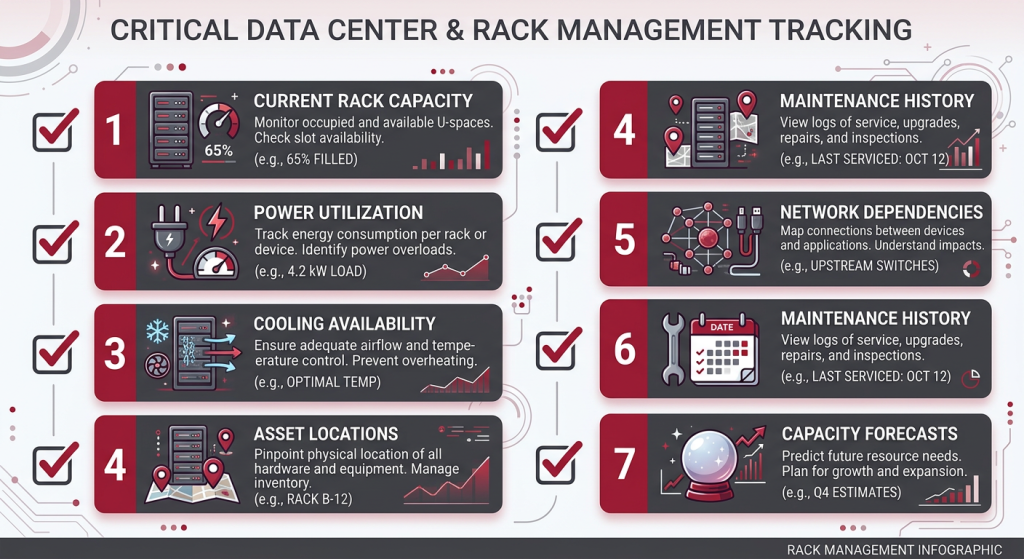
Without this context, responses become theoretical rather than operationally actionable. This is where MCP and LLMs begin to work together.
MCP enables AI systems to access authoritative sources of operational truth, while LLMs transform that data into understandable recommendations, analysis, and decision support.
Predictive Infrastructure Management
By connecting LLMs to real-time telemetry and operational systems through MCP, organizations can identify patterns that may indicate emerging risks. Infrastructure anomalies, thermal trends, or equipment degradation can be detected earlier, helping teams move from reactive to proactive operations.
Intelligent Capacity Planning
AI models can analyze available power, cooling, and space capacity while evaluating deployment scenarios. As AI workloads drive higher-density deployments, intelligent planning becomes increasingly important for avoiding stranded capacity and infrastructure bottlenecks.
Conversational Infrastructure Intelligence
Instead of manually reviewing dashboards and reports, operators can ask natural language questions such as:
"Which racks are approaching thermal thresholds?"
"Can we deploy another 100kW AI cluster?"
"What is the operational risk if cooling capacity drops by 10%?"
The combination of MCP and LLMs allows AI systems to retrieve live data and provide context-rich responses based on actual infrastructure conditions.
Automated Operational Workflows
MCP can also facilitate secure interaction between AI and operational systems, supporting automation opportunities such as resource provisioning, workflow orchestration, network management, and ticketing processes.
Where Nlyte Fits In
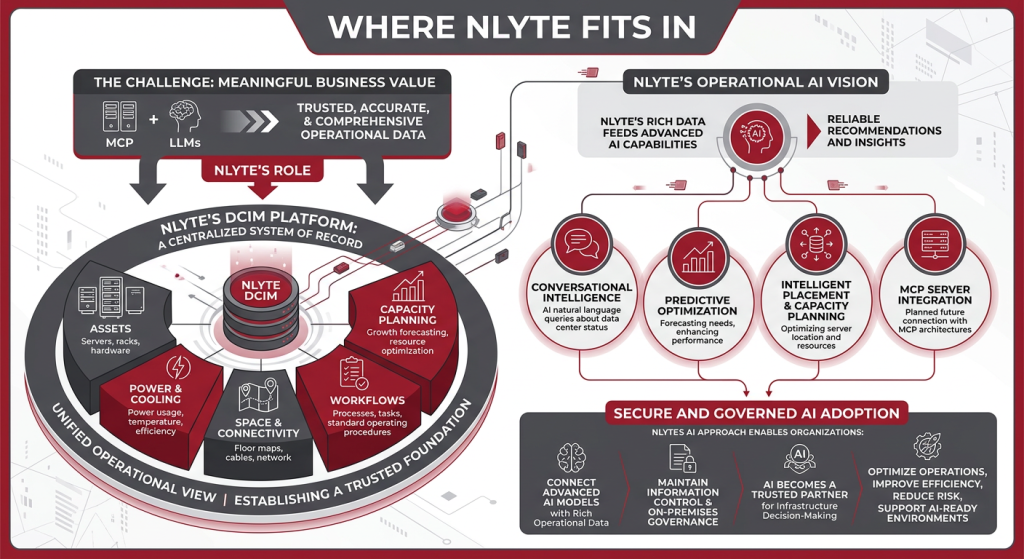
For MCP and LLMs to deliver meaningful business value, they require access to trusted, accurate, and comprehensive operational data.
This is where Nlyte plays a crucial role.
Nlyte's Data Center Infrastructure Management (DCIM) platform provides a centralized system of record for assets, power, cooling, space, connectivity, workflows, and capacity planning across data center environments. By creating a unified operational view, Nlyte establishes the trusted foundation that AI systems need to generate reliable recommendations and insights.


Request a Demo Today