
The Top 5 Ways to Manage Device Certificate Security in Modern Data Centers
Published on September 13, 2026,
by

Why Device Certificates Have Become a Critical Infrastructure Challenge
Data center security discussions often focus on firewalls, network segmentation, identity management, and endpoint protection. Yet one of the most overlooked components of cyber resilience lies within the infrastructure itself: the thousands of connected devices that power and monitor modern data centers.
Intelligent PDUs, environmental sensors, rack controllers, switches, and edge devices are now network-connected endpoints that require the same level of security governance as traditional IT assets. These devices depend on digital certificates to authenticate identity, establish trust, and enable encrypted communications. As infrastructure expands and certificate lifetimes continue to shrink, manual certificate management is becoming increasingly difficult to sustain.
Industry experts increasingly recognize that machine identities are now growing faster than human identities. As organizations deploy more connected infrastructure, automation and governance are becoming essential to maintaining operational security and preventing certificate-related outages.
The question is how quickly organizations can eliminate manual processes before certificate renewal cycles become even shorter and operational risk increases.
-
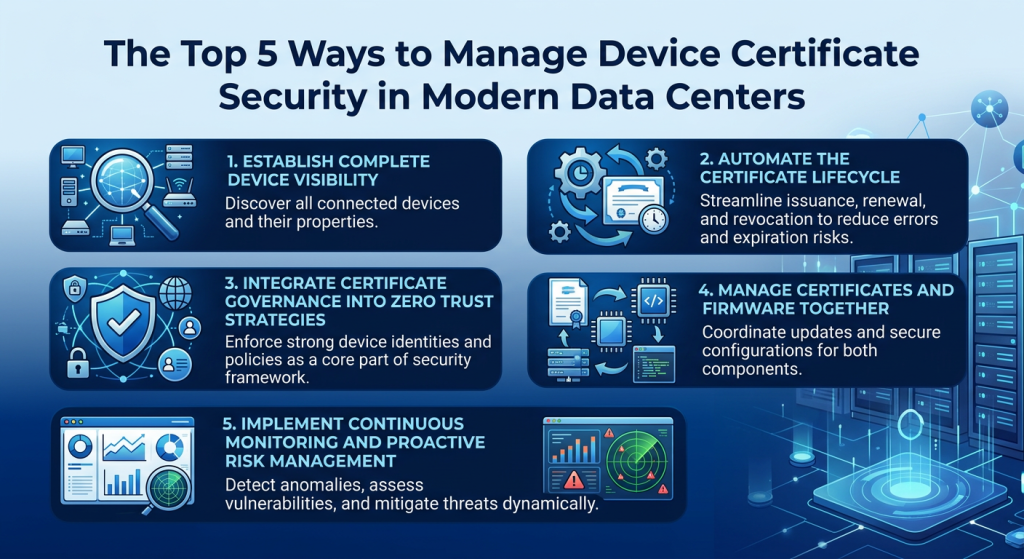
Establish Complete Device Visibility
You cannot secure what you cannot see.
Many organizations struggle to maintain an accurate inventory of infrastructure devices deployed across data centers, colocation facilities, and edge locations. Without visibility, teams often have limited awareness of:
- Which devices are connected
- Which certificates are installed
- Certificate expiration dates
- Firmware versions
- Device ownership and location
This lack of visibility creates significant operational risk.
A best-practice approach begins with maintaining a centralized inventory of all infrastructure devices and their associated certificates.
Key Takeaway
A complete inventory is the first step toward establishing trust, accountability, and security across modern infrastructure.
-
Automate the Certificate Lifecycle
Manual certificate management does not scale.
Historically, certificates remained valid for extended periods and could often be managed manually through spreadsheets and periodic reviews. Today, certificate lifetimes are becoming progressively shorter, significantly impacting administrative burden. Industry guidance increasingly emphasizes the importance of automated lifecycle management to avoid outages caused by expired certificates.
Organizations should automate:
- Certificate issuance
- Certificate deployment
- Certificate renewal
- Certificate replacement
- Certificate revocation
Automation helps ensure that certificates remain current, trusted, and compliant without relying on manual intervention.
Key Takeaway
Automated certificate lifecycle management reduces human error while improving resilience and operational efficiency.
-
Integrate Certificate Governance Into Zero Trust Strategies
Zero Trust is no longer just about users and applications.
Modern Zero Trust frameworks require every device to continuously prove its identity and integrity throughout its lifecycle. Infrastructure devices must be treated as first-class security assets rather than operational afterthoughts.
A mature Zero Trust approach should include:
- Continuous certificate validation
- Device authentication controls
- Certificate ownership tracking
- Identity verification
- Security policy enforcement
When device certificates are governed effectively, organizations gain confidence that infrastructure components remain trusted participants within the broader security architecture.
Key Takeaway
Trust must be continuously verified, not assumed.
-
Manage Certificates and Firmware Together
Device trust extends beyond certificates alone.
A device can possess a valid certificate yet still remain vulnerable if firmware is outdated or compromised. Security and operations teams should adopt a holistic approach that combines certificate management with firmware governance.
Successful organizations align:
- Device identity
- Certificate health
- Firmware status
- Configuration compliance
- Security policy management
A unified governance strategy provides stronger protection against vulnerabilities while reducing the administrative burden associated with managing multiple disconnected tools.
As reported across the industry, infrastructure teams are increasingly challenged by heterogeneous environments consisting of multiple vendors, firmware versions, and management platforms. Consolidation and automation have become essential to maintaining a consistent security posture.
Key Takeaway
Digital certificates and firmware are inseparable components of infrastructure trust.
-
Implement Continuous Monitoring and Proactive Risk Management
Certificate security should never be a periodic exercise.
Organizations that actively monitor certificate status, firmware compliance, and device health are better positioned to detect issues before they become operational disruptions.
Continuous monitoring enables teams to:
- Identify expiring certificates
- Detect unauthorized configuration changes
- Monitor certificate health
- Improve compliance readiness
This proactive approach helps reduce the likelihood of outages while strengthening overall cyber resilience. It also supports audit requirements and regulatory frameworks that increasingly demand evidence of strong infrastructure governance.
Key Takeaway
The most resilient organizations identify trust failures before they impact operations.
Where Nlyte Fits In
As organizations confront the realities of shrinking certificate lifetimes, expanding edge deployments, and increasingly complex infrastructure environments, they need more than manual processes and disconnected tools. They need a centralized approach to managing device trust at scale.
Nlyte Device Management delivers a vendor-agnostic platform designed to automate certificate lifecycle management, streamline firmware governance, and enhance security monitoring across multi-vendor infrastructure environments. By doing so, organizations gain centralized visibility and policy-driven control while reducing the reliance on manual processes. In addition, integrating certificate management with device intelligence and firmware security enables infrastructure teams to proactively reduce outage risk, strengthen cyber resilience, and advance Zero Trust strategies. Meanwhile, automated workflows improve operational efficiency and help maintain compliance across increasingly complex environments. As AI, edge computing, and distributed infrastructure continue to grow, the need for scalable device governance becomes even more critical. Consequently, Nlyte helps organizations maintain secure, trusted, and compliant operations across their connected infrastructure ecosystem.
The Future of Infrastructure Trust
Device certificates have become the digital passports of modern infrastructure. They establish trust, secure communications, and support resilience across increasingly interconnected environments.
Organizations that continue relying on manual processes face growing risks from certificate expirations, inconsistent governance, and operational blind spots. Those that embrace automation, visibility, and integrated lifecycle management will be better positioned to support secure growth, maintain compliance, and protect critical infrastructure.
As digital infrastructure evolves, managing device trust has become a core operational requirement for ensuring reliability, resilience, and business continuity in the AI-powered data centers of tomorrow.
Contact a Nlyte expert, to discover how Nlyte Device Management helps organizations automate device certificate and firmware security while improving operational resilience across modern data center environments.


Request a Demo Today