
Power, Performance, and Precision: How AI is Redefining Data Center Management
Published on June 9, 2026,
by

The Evolving Role of AI in Data Centers
Artificial intelligence is rapidly transforming the data center landscape. While discussions often focus on the increased power demand driven by AI workloads, this perspective overlooks a critical reality. AI is also enabling ever increasing efficiency, intelligence, and operational control.
Rather than viewing AI purely as a source of energy consumption, data center operators are increasingly recognizing its role as a strategic enabler. When applied effectively, AI introduces smarter decision-making, enhanced visibility, and improved performance across infrastructure environments.
Understanding the Power Debate Around AI
AI workloads, particularly those involving large-scale model training and real-time inference, require significant computing power. High-density environments, (Graphics Processing Unit) GPU-driven architectures, and advanced cooling systems are now essential components of modern facilities.
However, this is not a new pattern. Data centers have consistently evolved to support more demanding technologies, from virtualization to cloud computing and hyperscale operations. Each shift increased power density but also delivered measurable gains in efficiency, scalability, and operational agility.
AI is following the same trajectory. While it raises infrastructure requirements, it simultaneously unlocks new ways to optimize and manage resources more effectively.
AI as a Catalyst for Operational Intelligence
One of AI’s most transformative contributions is its ability to act as an operational intelligence layer within the data center.
Modern facilities generate vast volumes of data across power systems, cooling infrastructure, IT assets, and environmental sensors. Traditionally, much of this information remained siloed or underutilized. AI changes this by continuously analyzing both real-time and historical data to generate actionable insights.
This enables a shift from:
- Reactive operations (responding after issues occur)
- Preventive maintenance (based on static schedules)
to:
- Predictive operations, where potential issues are identified in advance
- Prescriptive actions, where systems recommend the optimal response
The result is improved resilience, reduced downtime risk, and more efficient operations.
Smarter Power and Capacity Management
AI-driven analytics provide a more accurate understanding of how power and capacity are used within the data center.
Instead of relying on conservative, worst-case assumptions, organizations can:
- Identify underutilized assets and stranded capacity
- Detect overprovisioned racks and inefficient layouts
- Model real-world usage patterns for better forecasting
This level of insight allows operators to maximize existing infrastructure, delay unnecessary capital expenditure, and make more informed decisions about future expansion. Particularly in environments where power availability is constrained.
Intelligent Cooling Optimization
Cooling remains one of the largest contributors to data center energy consumption. AI is uniquely suited to optimize these systems in dynamic environments where variables such as workload demand, hardware density, and external conditions constantly fluctuate.
By continuously analyzing operational data, AI can:
- Adjust cooling distribution in real time
- Optimize airflow and temperature set points
- Align cooling capacity with actual workload demand
This reduces energy waste, enhances thermal efficiency, and extends the lifespan of critical infrastructure components. Importantly, AI augments human expertise rather than replacing it, enabling teams to make more informed decisions at scale.
Turning Sustainability Goals into Measurable Action
Sustainability is now a top priority for data center operators, yet translating targets into tangible outcomes remains a challenge.
AI bridges this gap by connecting operational data with environmental impact. It enables organizations to:
- Track energy usage more accurately
- Improve carbon reporting and compliance
- Model the impact of operational changes before implementation
Whether adjusting workload placement, upgrading equipment, or refining power strategies, AI provides the intelligence needed to turn sustainability initiatives into measurable progress, and long-term competitive advantage.
The Nlyte Advantage: Operational AI for Data Centers
By integrating AI into its DCIM platform, Nlyte enables organizations to:
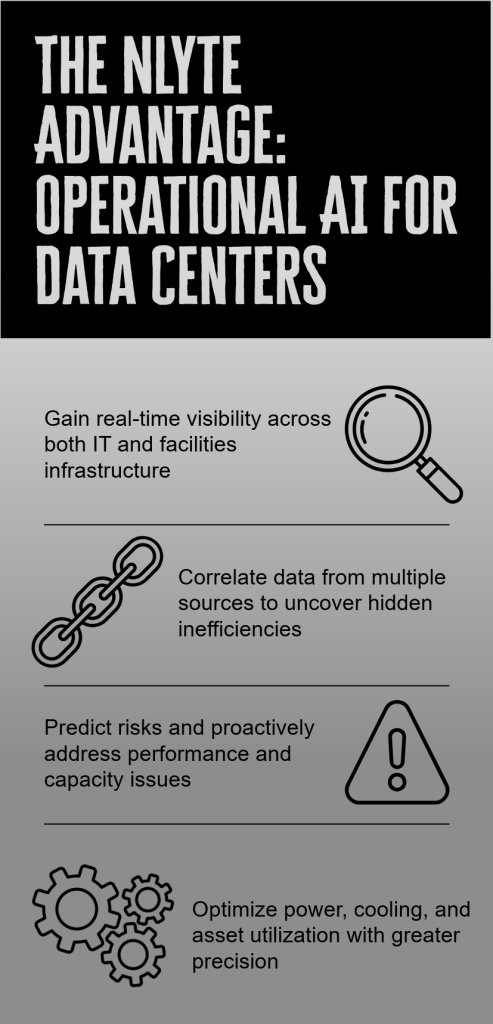
Nlyte brings advanced Operational AI capabilities to data center management through Nlyte Intelligence Operational AI, its conversational intelligence solution designed to simplify and accelerate decision-making. By combining the Nlyte Intelligence Agent (available on the Microsoft Marketplace) with the Nlyte Intelligence Connector, the platform securely unifies asset, power, cooling, space, and network data across the data center. This enables teams to interact with complex infrastructure environments using natural language, replacing manual analysis of dashboards and static reports with clear, contextual, and actionable responses grounded in live operational data.
Through intelligent data correlation across infrastructure domains, Nlyte Intelligence empowers organizations to move from insight to action more quickly, improving operational awareness, efficiency, and control. Teams can forecast capacity, identify risks, and make informed decisions without time-intensive analysis, all while maintaining secure, on-premises deployment and full data ownership. The solution delivers value across multiple roles, from facilities and network teams to service desks, asset managers, and finance stakeholders, ensuring consistent, data-driven visibility across the organization.
Rethinking AI’s Role in Data Center Strategy
The narrative that “AI simply increases power consumption” is incomplete. While demand is rising, AI is also enabling data centers to operate with greater efficiency, agility, and insight than ever before.
Organizations that embrace AI as part of their data center strategy can:
- Improve infrastructure performance while managing energy demand
- Enhance operational visibility and control
- Support sustainability goals with measurable outcomes
- Scale confidently in response to growing digital needs
Conclusion: Turning AI Potential into Operational Advantage
Artificial intelligence is transforming data center management from a reactive discipline into an intelligent, proactive strategy, enabling organizations to balance rising power demands with greater efficiency, visibility, and control. By turning vast volumes of operational data into actionable insight, AI supports predictive and prescriptive decision-making that reduces risk, improves resilience, and optimizes performance across power, cooling, and asset utilization. It also plays a critical role in advancing sustainability by providing precise, measurable ways to reduce energy consumption and align operations with environmental goals. With solutions like Nlyte’s Operational AI, organizations can move beyond static management approaches to create adaptive, data-driven environments that enhance operational performance, maximize infrastructure value, and support scalable, future-ready growth.


Request a Demo Today