
The Death of Reactive Cooling at 100kW+
Published on July 27, 2026,
by

When an artificial intelligence (AI) training cluster spins up, it does not gradually increase its workload. The thermal output jumps instantly. A rack full of high-performance GPUs shifts from idle to maximum utilization in a fraction of a second, drawing massive amounts of power and radiating intense heat.
For decades, data center operators managed thermal loads reactively. A sensor detected a rise in temperature, and the facility responded by spinning up fans, opening valves, or pushing more chilled water into the room. This approach worked well enough for traditional enterprise computing.
Today, that reactive approach is effectively dead.
As rack densities push past 100kW, traditional cooling methods fail to keep up with the sheer speed of AI thermal spikes. Air cooling maxes out at roughly 30kW per rack. To survive the modern AI era, data centers rely on liquid-to-liquid Coolant Distribution Units (CDUs) and direct-to-chip cooling systems. However, even liquid cooling falls short if the control system waits for the heat to arrive before it reacts.
To protect expensive equipment and stop wasting energy, data centers must shift their strategy. They need predictive cooling for AI. By utilizing predictive load signals from the IT stack, facility managers can pre-cool fluid loops and adjust chiller plants before the compute load peaks.
The AI Power Shockwave: Why 100kW+ Changes Everything
Artificial intelligence workloads are uniquely demanding. Unlike standard web servers that experience predictable, rolling waves of traffic, machine learning models execute massive, parallel processing jobs simultaneously.
When a data scientist launches a large language model (LLM) training sequence, thousands of GPUs engage at once. According to reports from Data Center Dynamics (DCD), this instantaneous demand creates a thermal "shockwave" within the data center. The power draw inside a single cabinet can instantly skyrocket from a baseline of a few kilowatts to well over 100 kilowatts.
Research from the JLL Global Data Center Outlook confirms that this rapid escalation in rack density is becoming the new standard. Facilities that previously averaged 5kW to 10kW per rack are now retrofitting to support 50kW, 80kW, and 100kW+ footprints to accommodate Nvidia, AMD, and custom silicon clusters.
Why Air-Cooling Hits a Wall
At 100kW, air cooling is no longer a matter of diminishing returns; it violates the laws of thermal dynamics. Air lacks the density and heat capacity to carry away the thermal energy generated by tightly packed AI servers.
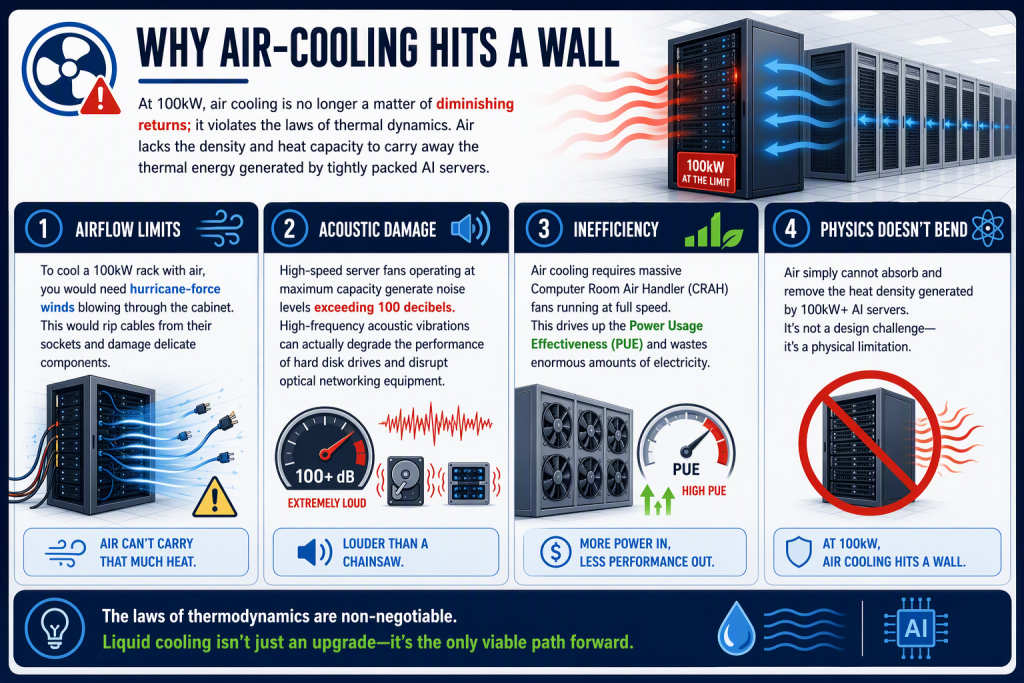
- Airflow Limits: To cool a 100kW rack with air, you would need hurricane-force winds blowing through the cabinet. This would rip cables from their sockets and damage delicate components.
- Acoustic Damage: High-speed server fans operating at maximum capacity generate noise levels exceeding 100 decibels. High-frequency acoustic vibrations can actually degrade the performance of hard disk drives and disrupt optical networking equipment.
- Inefficiency: Air cooling requires massive computer room air handler (CRAH) fans running at full speed. This drives up the Power Usage Effectiveness (PUE) and wastes enormous amounts of electricity.
The Uptime Institute consistently notes that moving beyond 30kW requires liquid cooling. Liquid holds roughly 3,000 times more heat by volume than air. Direct-to-chip systems and liquid-to-liquid CDUs bring the coolant directly to the heat source, bypassing the inefficiencies of moving vast volumes of air.
The Reactive Cooling Trap
Upgrading to liquid cooling solves the capacity problem, but it does not solve the timing problem.
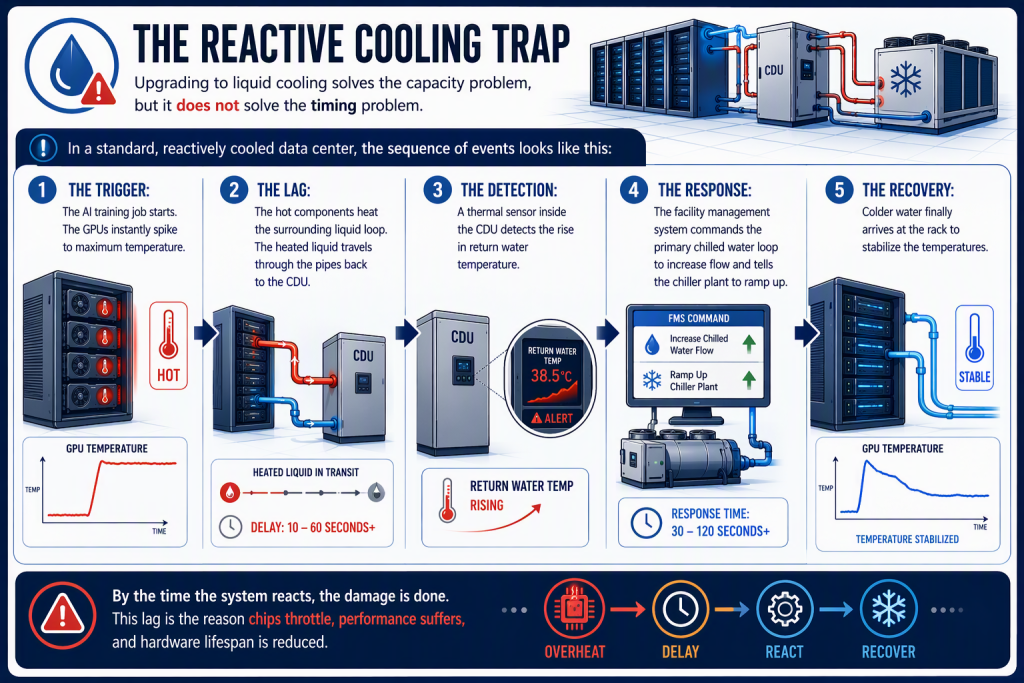
In a standard, reactively cooled data center, the sequence of events looks like this:
- The Trigger: The AI training job starts. The GPUs instantly spike to maximum temperature.
- The Lag: The hot components heat the surrounding liquid loop. The heated liquid travels through the pipes back to the CDU.
- The Detection: A thermal sensor inside the CDU detects the rise in return water temperature.
- The Response: The facility management system commands the primary chilled water loop to increase flow and tells the chiller plant to ramp up.
- The Recovery: Colder water finally arrives at the rack to stabilize the temperatures.
This reactive loop creates a dangerous time gap. According to Data Center Knowledge, that gap can last anywhere from 30 seconds to several minutes, depending on the pipe length and system design.
During that lag, the GPUs overheat. To prevent physical meltdown, the chips engage thermal throttling. They artificially slow themselves down, dropping their clock speeds to generate less heat.
Thermal throttling destroys the entire purpose of buying expensive AI hardware. If your million-dollar GPU cluster slows down by 30% every time a workload spikes, you are losing massive amounts of computational value. Furthermore, repeated exposure to thermal spikes degrades the silicon over time, shortening the lifespan of your critical infrastructure.
Comparing Data Center Cooling Strategies
To understand the evolution of thermal management, we must look at how different systems handle a sudden AI workload spike.
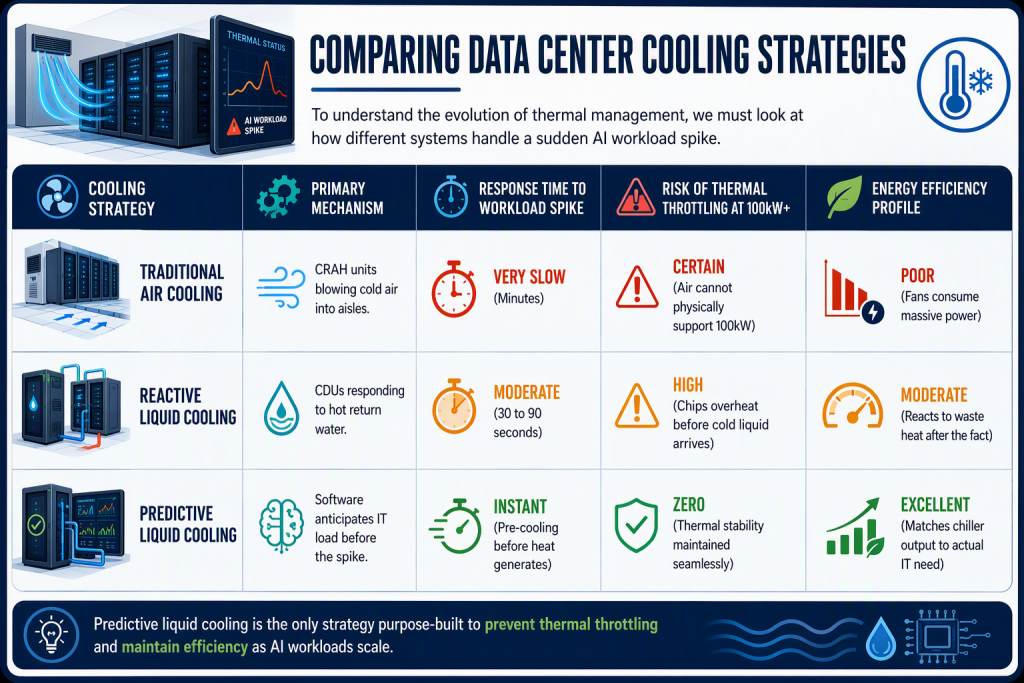
The table below is the same information outlined in the infographic above.
| Cooling Strategy | Primary Mechanism | Response Time to Workload Spike | Risk of Thermal Throttling at 100kW+ | Energy Efficiency Profile |
| Traditional Air Cooling | CRAH units blowing cold air into aisles. | Very Slow (Minutes) | Certain (Air cannot physically support 100kW) | Poor (Fans consume massive power) |
| Reactive Liquid Cooling | CDUs responding to hot return water. | Moderate (30 to 90 seconds) | High (Chips overheat before cold liquid arrives) | Moderate (Reacts to waste heat after the fact) |
| Predictive Liquid Cooling | Software anticipates IT load before the spike. | Instant (Pre-cooling before heat generates) | Zero (Thermal stability maintained seamlessly) | Excellent (Matches chiller output to actual IT need) |
The Nlyte Advantage: Predictive Load Signals
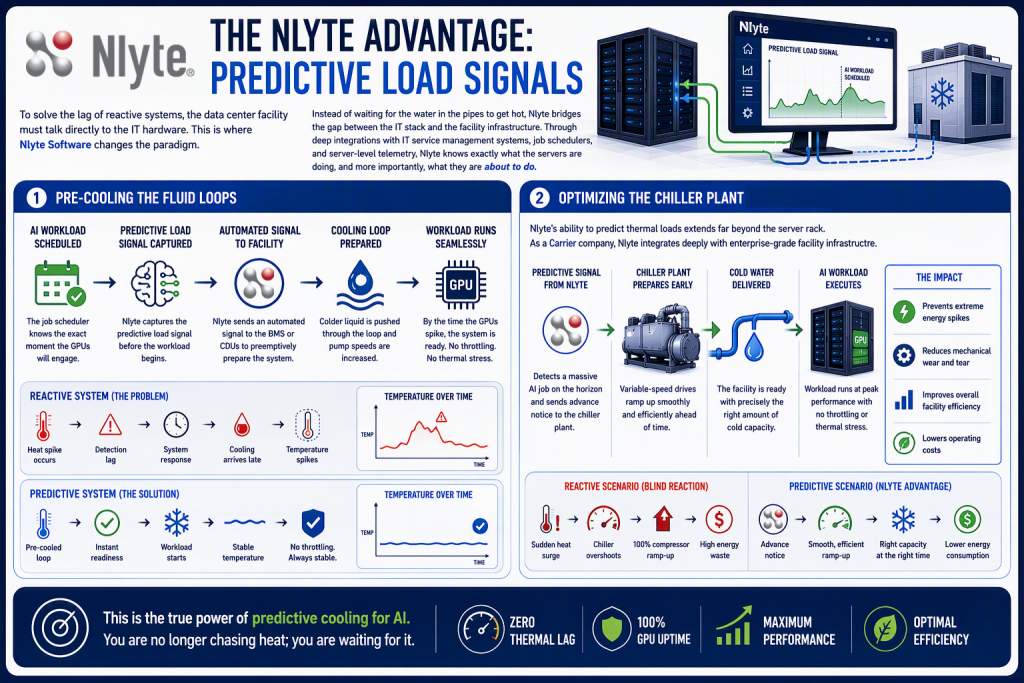
To solve the lag of reactive systems, the data center facility must talk directly to the IT hardware. This is where Nlyte Software changes the paradigm.
Instead of waiting for the water in the pipes to get hot, Nlyte bridges the gap between the IT stack and the facility infrastructure. Through deep integrations with IT service management systems, job schedulers, and server-level telemetry, Nlyte knows exactly what the servers are doing, and more importantly, what they are about to do.
Pre-Cooling the Fluid Loops
When an AI workload is scheduled to run, the IT orchestration layer knows the exact moment the GPUs will engage. Nlyte captures this predictive load signal.
Before the GPUs even begin to process the data, Nlyte sends an automated signal to the facility’s Building Management System (BMS) or directly to the Coolant Distribution Units. The facility begins pushing colder liquid and increasing pump speeds preemptively.
By the time the GPUs generate their thermal spike, the cooling loop is already saturated with precisely the right amount of cold liquid to absorb the heat instantly. The temperature curve remains perfectly flat. The GPUs never throttle, and the hardware never experiences thermal stress.
This is the true power of predictive cooling for AI. You are no longer chasing heat; you are waiting for it.
Optimizing the Chiller Plant with Carrier
Nlyte’s ability to predict thermal loads extends far beyond the server rack. As a Carrier company, Nlyte integrates deeply with enterprise-grade facility infrastructure.
When Nlyte detects a massive AI job on the horizon, it can communicate with the central chiller plant. Chiller plants use massive compressors and variable-speed drives (VSDs) to generate the cold water that feeds the data center. Ramping these systems up takes time and requires significant energy.
If a chiller plant reacts blindly to a sudden surge in heat, it often "overshoots." It ramps up its compressors to 100% to fight the sudden temperature spike, wasting tremendous amounts of electricity, before eventually dialing back down.
With Nlyte’s predictive signaling, the chiller plant receives advance notice. The variable-speed drives can ramp up smoothly and efficiently ahead of time. This prevents extreme energy spikes, reduces mechanical wear and tear on the Carrier chillers, and drastically improves the overall efficiency of the facility.
Powering the High-Density Era: Renewable Energy
As data centers embrace predictive cooling for AI, they also face a broader challenge: sourcing the immense power required to run 100kW+ racks. The transition to liquid cooling improves efficiency, but the absolute power draw of AI facilities continues to climb.
Leading analysts at Newmark and Colliers stress that sustainability mandates are forcing data centers to move away from fossil fuels. Major hyperscalers and colocation providers are actively integrating renewable energy sources into their high-density site selections.
However, matching the constant, baseload power requirements of an AI data center with the variable nature of renewable energy requires careful planning. Operators must balance space constraints, upfront costs, and reliability.
Data Center Renewable Energy Comparison
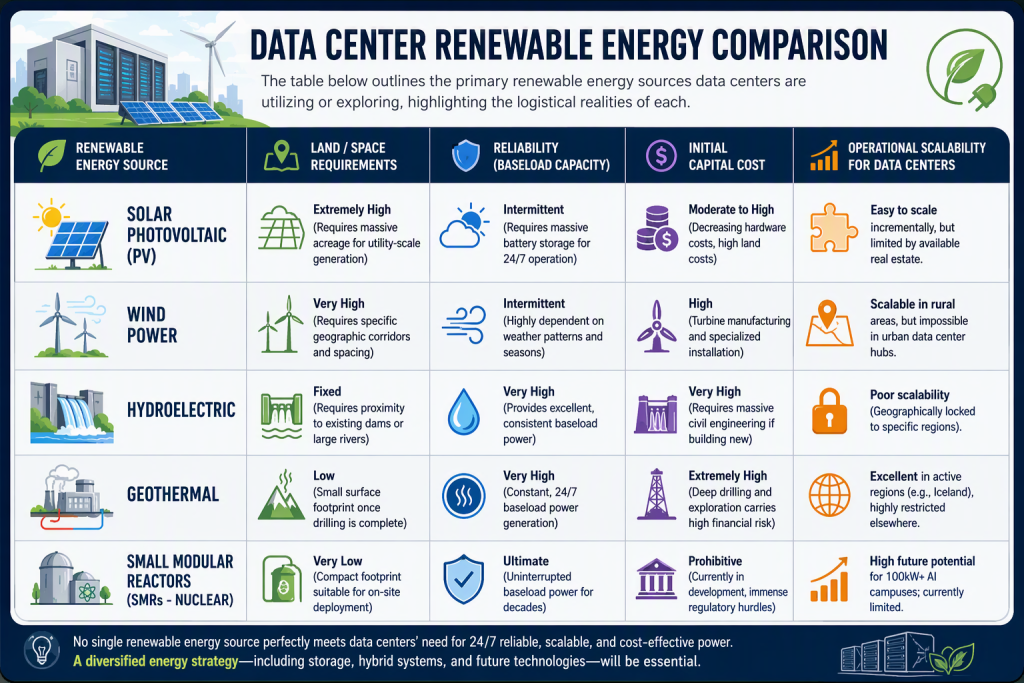
The table below is the same information outlined in the infographic above.
| Renewable Energy Source | Land / Space Requirements | Reliability (Baseload Capacity) | Initial Capital Cost | Operational Scalability for Data Centers |
| Solar Photovoltaic (PV) | Extremely High (Requires massive acreage for utility-scale generation) | Intermittent (Requires massive battery storage for 24/7 operation) | Moderate to High (Decreasing hardware costs, high land costs) | Easy to scale incrementally, but limited by available real estate. |
| Wind Power | Very High (Requires specific geographic corridors and spacing) | Intermittent (Highly dependent on weather patterns and seasons) | High (Turbine manufacturing and specialized installation) | Scalable in rural areas, but impossible in urban data center hubs. |
| Hydroelectric | Fixed (Requires proximity to existing dams or large rivers) | Very High (Provides excellent, consistent baseload power) | Very High (Requires massive civil engineering if building new) | Poor scalability (Geographically locked to specific regions). |
| Geothermal | Low (Small surface footprint once drilling is complete) | Very High (Constant, 24/7 baseload power generation) | Extremely High (Deep drilling and exploration carries high financial risk) | Excellent in active regions (e.g., Iceland), highly restricted elsewhere. |
| Small Modular Reactors (SMRs - Nuclear) | Very Low (Compact footprint suitable for on-site deployment) | Ultimate (Uninterrupted baseload power for decades) | Prohibitive (Currently in development, immense regulatory hurdles) | High future potential for 100kW+ AI campuses; currently limited. |
By utilizing Operational AI, data centers can better align their compute workloads with the availability of renewable energy. If a facility relies heavily on solar power, Nlyte can help schedule non-urgent AI training workloads during peak daylight hours when cheap, renewable energy is abundant. This synergy between IT orchestration, facility cooling, and power procurement represents the pinnacle of modern data center management.
The Future Belongs to the Proactive
The days of waiting for a server to get hot before attempting to cool it are over. The physics of 100kW+ AI racks absolutely forbid it.
Relying on reactive thermal management guarantees thermal throttling, damages expensive GPU clusters, and forces cooling equipment into inefficient, reactive energy spikes. Transitioning to liquid cooling is a mandatory first step, but the hardware alone is not enough. You need the software intelligence to drive it.
Data centers must bridge the gap between the IT workload and the facility infrastructure. By implementing predictive cooling for AI, operators guarantee thermal stability, maximize GPU utilization, and significantly lower their cooling energy costs. By leveraging Nlyte Software and Carrier’s advanced infrastructure capabilities, your facility can anticipate the heat before it ever materializes.
Stop reacting to the heat. Start predicting it.
Take control of your high-density AI infrastructure today. Engage with Nlyte Software to see how predictive load signaling and Operational AI can protect your hardware and optimize your facility.
Request a demo here: https://www.nlyte.com/nlyte-in-action/see-a-demo/


Request a Demo Today