
Why Measuring Compute Value per Kilowatt Is the Next Frontier in Data Center Performance
Published on May 22, 2026,
by

For years, data center efficiency has largely been defined by a single metric: Power Usage Effectiveness (PUE). PUE helped the industry move beyond raw energy consumption, driving major improvements in cooling efficiency, power distribution, and facility design. It established a critical baseline for understanding how efficiently energy enters and moves through the data center.
Yet today’s data centers are operating in a very different reality.
With the rapid expansion of AI‑driven workloads, high‑density deployments, Graphics Processing Unit (GPUs), and accelerated computing, the central challenge is maximizing the value of that power once it reaches the IT load. This shift is bringing new attention to a complementary concept: Power Compute Effectiveness (PCE).
From Infrastructure Efficiency to Compute Outcomes
PUE answers an important operational question. How efficiently power is delivered to IT equipment is often measured; however, it does not, in itself, indicate whether that power is being used effectively.
Furthermore, while two facilities may report the same PUE, they can, nevertheless, deliver dramatically different levels of performance and business value. For instance, one facility may operate with underutilized servers, poorly matched workloads, or idle high‑power infrastructure and, as a result, fail to maximise its energy use.
By contrast, another facility may, in turn, extract significantly more compute output from the same energy footprint, as this is achieved through more effective workload placement, improved utilisation, and continuous system optimisation.
Power Compute Effectiveness (PCE) addresses this gap by shifting the conversation from infrastructure efficiency alone to compute effectiveness. It focuses on understanding how much of the energy consumed by a data center is translated into useful computational work, rather than simply measuring how efficiently power is delivered.
Why Power Compute Effectiveness Is Becoming Essential
Several industry pressures are accelerating the need to look beyond traditional efficiency metrics:
- Explosive Growth of AI and High‑Density Compute
AI workloads demand far more power per rack, yet their business value depends heavily on utilization, scheduling, and architectural efficiency. Simply supplying power efficiently does not guarantee optimal outcomes.
- Operating Under Power Constraints
Power availability has become one of the primary limiting factors for data center growth. In many regions, facilities cannot draw more power from the grid, making it essential to generate more compute value from existing capacity.
- Rising Sustainability and Regulatory Expectations
Organizations are under increasing pressure to demonstrate responsible energy usage. Measuring effectiveness, not just efficiency, is key to showing how energy consumption directly supports business outcomes.
- The Need for IT and Facilities Alignment
Traditional metrics often reinforce silos. PCE encourages a shared view between facilities, IT, and business teams by linking energy use directly to workload performance and value delivered.
What Power Compute Effectiveness Actually Looks At
PCE focuses on the relationship between three critical variables:
- Power consumed
- Compute capacity and performance delivered
- Workloads executed
To do this, it pushes visibility beyond infrastructure alone into areas such as:
- CPU, GPU, and accelerator utilization
- Workload efficiency and placement
- Idle or stranded capacity
- Over‑provisioned power and cooling resources
Rather than treating all IT load as equally productive, PCE reveals where power is delivering meaningful results, and where it is simply being consumed.
How PCE Expands Efficiency Metrics Like PUE
PUE remains a vital operational metric, but on its own it only answers part of the efficiency equation.
- PUE measures how efficiently energy reaches IT equipment.
- PCE evaluates how effectively that energy is converted into valuable compute outcomes.
Together, they deliver a clearer and more accurate view of data center performance. As a result, infrastructure efficiency is directly linked to real‑world workload impact. Ultimately, this connection highlights the business value created by every unit of power consumed.
The Role of Nlyte DCIM in Enabling Power Compute Effectiveness
Generating meaningful PCE insights requires intelligent visibility across both the physical and IT layers. Without this unified view, true effectiveness cannot be measured. This is where Nlyte’s Data Center Infrastructure Management (DCIM) platform delivers distinct value.
Nlyte brings together real‑time data from power, cooling, space, IT assets, and workloads into a single operational view. As a result, power consumption can be directly correlated with compute utilization and workload behavior. This insight allows operators to uncover stranded capacity, identify underutilized infrastructure, and pinpoint opportunities to deliver greater compute value from every kilowatt.
With Nlyte DCIM, organizations can:
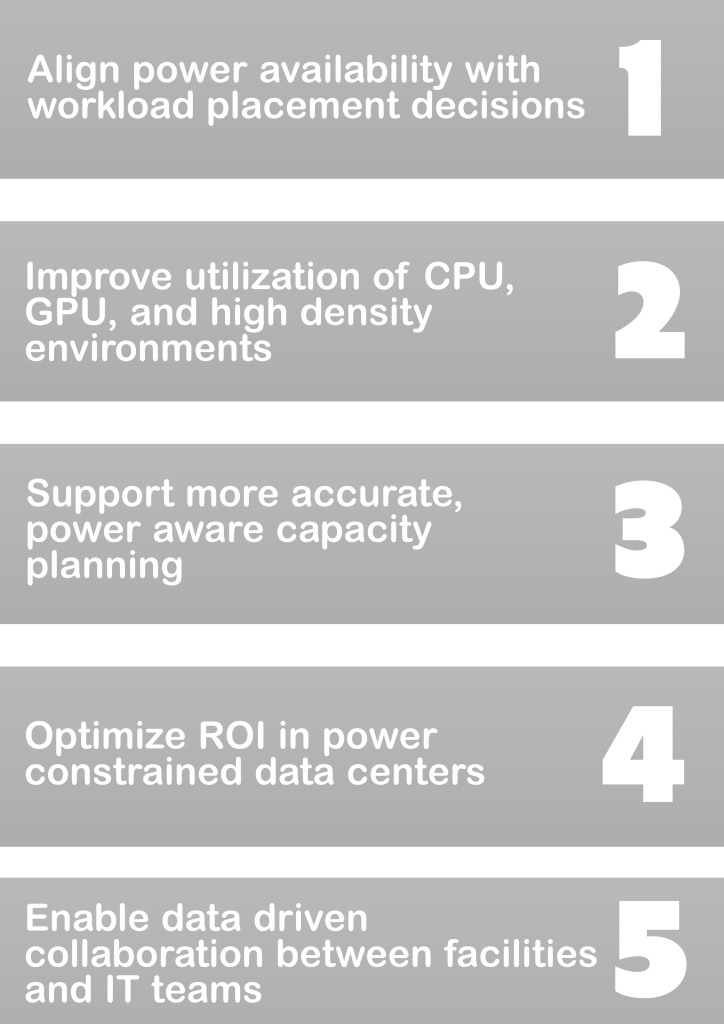
In the context of PCE, Nlyte turns raw telemetry into actionable intelligence. As a result, data moves beyond static metrics. Instead, effectiveness becomes measurable in real operational terms. Ultimately, this shift enables practical, outcome‑driven decisions rather than theoretical assessments.
Intelligence and Automation as the Foundation for PCE
PCE depends on the ability to correlate power, compute, and context continuously. As data centers generate increasingly rich streams of telemetry, AI‑driven analytics and automation are becoming essential.
By combining DCIM with intelligent analytics, operators can dynamically adapt operations based on real‑time conditions, ensuring power is directed where it delivers the greatest value. This marks a shift toward intelligent, adaptive data center management, where success is measured by outcomes, not inputs alone.
Redefining Data Center Performance for the Future
PUE helped the industry take a critical first step toward energy efficiency. Power Compute Effectiveness represents the next evolution. One that recognizes energy as a strategic resource and measures success by what that energy enables.
As AI adoption accelerates, power constraints tighten, and sustainability expectations grow, data center operators must look beyond efficiency in isolation. The future belongs to those who can maximize compute value per kilowatt, aligning performance, responsibility, and business impact.
With intelligent DCIM and Operational AI, organizations can move confidently toward this next generation of data center performance.


Request a Demo Today