Data Center Device Certificate Management: Act Now!
Published on February 20, 2026,
by

Why You Must Act Before March 15, 2026
If your data center runs thousands of intelligent devices, rack PDUs, power strips, and other connected infrastructure, you already manage a complex operational surface. Now the rules are changing in a way that will make manual security practices break.
Starting March 15, 2026, the maximum lifetime of publicly trusted TLS certificates begins a sharp reduction. The industry schedule drops certificate validity from 398 days to 200 days, then 100 days, and finally 47 days after March 15, 2029.
That timeline is not hypothetical. The CA/Browser Forum has adopted it through Ballot SC081v3, with major browser “certificate consumers” voting yes.
Here is the uncomfortable truth: shorter certificate lifetimes force automation. DigiCert’s analysis makes that explicit: 47-day lifetimes make manual workflows fragile and outage-prone.
And while most teams think first about web servers and customer-facing apps, a quieter and often overlooked category faces the same pressure: data center edge devices, especially intelligent rack PDUs. Your presentation calls out why: these devices are everywhere, they are heterogeneous, and they already demand heavy configuration and maintenance effort.
So the question is no longer “Should we modernize?”
The question is: How quickly can we eliminate manual device certificate work before the renewal cycle accelerates?
This article explains what is changing, why it increases risk, and how to respond—while also addressing a related pressure point for operators: energy and sustainability. You’ll get a practical renewable energy comparison table, plus a clear next step to reduce exposure fast.
What is changing: TLS certificate lifetimes shrink on a fixed schedule
The CA/Browser Forum’s SC-081 ballot introduces a staged reduction in the maximum validity period for publicly trusted TLS certificates.
The schedule is straightforward:
- Until March 15, 2026: max lifetime 398 days
- March 15, 2026 – March 15, 2027: max lifetime 200 days
- March 15, 2027 – March 15, 2029: max lifetime 100 days
- After March 15, 2029: max lifetime 47 days
DigiCert’s summary is clear about the operational impact: the first user-facing changes begin in March 2026, and the end state makes frequent renewal “the new normal.”
This matters because certificates are not “set-and-forget.” They require continuous discovery, renewal, and replacement. NIST’s guidance on TLS certificate management frames this as lifecycle work that organizations must execute reliably to maintain trust.
When the renewal interval shrinks, two risks rise quickly:
- Outages from expired or mis-deployed certificates
- Security exposure from inconsistent policy enforcement and weak visibility
That is true for web workloads. But it becomes even more dangerous for device fleets where teams still rely on manual steps.
Why PDUs and power devices amplify the risk
Your presentation highlights a key market reality: power strips are often the most numerous infrastructure assets in the data center.
That density matters. If a team struggles to manage certificates across a handful of systems, imagine doing it across thousands of devices distributed across rooms, rows, and remote sites.
The deck also spells out the starting condition many operators face:
- Power strips ship with manufacturer-issued HTTPS certificates that customers consider “untrusted.
- Without a trusted certificate, teams may fall back to unencrypted HTTP, sending traffic (including credentials) in plain text.
- The “only current solution” in many environments is to install certificates manually via UI or USB stick, per device.
That last point is where urgency spikes. If you touch each device manually today, the SC-081 schedule will multiply your workload. Worse, a rushed, manual approach invites inconsistent configurations.
Meanwhile, modern PDU environments require regular maintenance beyond certificates. Firmware updates alone can become painful at scale, and industry guidance consistently frames firmware updates as essential for cybersecurity and reliability. For example, Panduit notes that firmware updates deliver security patches and bug fixes, but they become time-consuming across large multi-vendor device populations.
Data Center Dynamics also emphasizes that intelligent rack PDUs and their firmware capabilities matter for real-time monitoring and operational discipline at the rack.
In short: PDUs combine high volume, high impact, and high operational friction. That makes them the wrong place to rely on manual certificate work.
The security stakes: “untrusted” certificates and the hidden attack surface
As PDUs evolved from simple power strips into networked endpoints, they also became part of the security perimeter. The product page you’re directing readers to highlights this shift directly: intelligent PDUs expand the attack surface, and researchers have reported severe vulnerabilities across multiple vendors, sometimes enabling remote takeover.
This is why data center device certificate management is not just a compliance exercise. It is a practical control that protects:
- device authentication
- encrypted management sessions
- operator credentials in transit
- the reliability of rack-level power control
And because certificate lifetimes are shrinking, the control must scale.
Why manual processes collapse under a 200-day (and later 47-day) cycle
1) Volume beats people
Thousands of devices multiplied by more frequent renewals becomes a constant treadmill. Your deck explicitly calls out the “ongoing administrative burden” of tracking renewals and renewing certificates device-by-device.
2) Heterogeneity breaks standardization
Data centers are “almost always heterogeneous,” with multiple vendors and models creating inconsistent management options
3) Risk increases as change frequency rises
DigiCert’s SC-081 explainer makes the underlying point: as lifetimes shrink, organizations must plan around automation because the cycle becomes too tight for manual work.
NIST’s TLS certificate management guidance similarly emphasizes disciplined lifecycle operations as a security requirement.
This is exactly why modern certificate programs invest in:
- inventory and discovery
- automated issuance/renewal
- policy enforcement
- reliable deployment
Those same principles apply to device fleets, not just websites.
What “good” looks like: the minimum requirements for device certificate management now
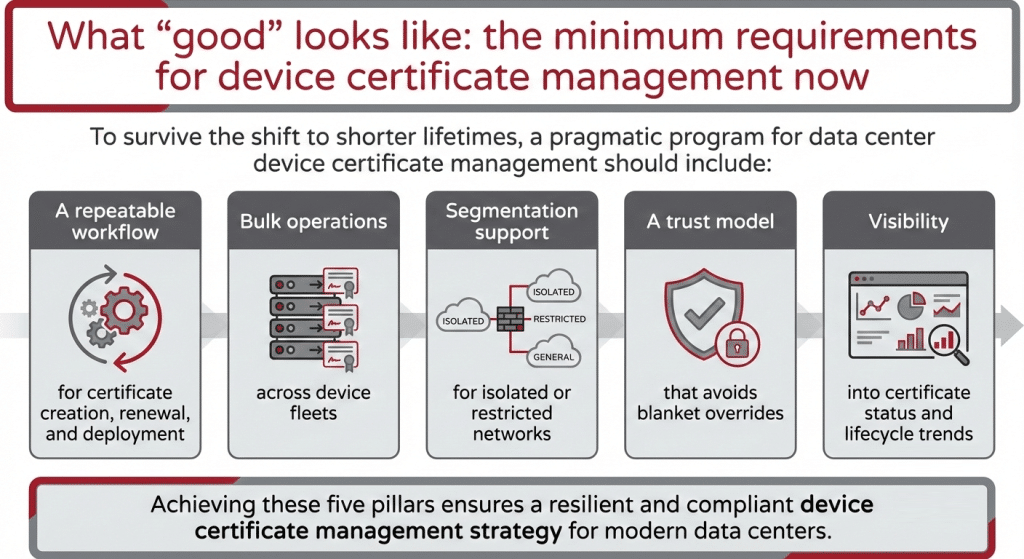
To survive the shift to shorter lifetimes, a pragmatic program for data center device certificate management should include:
- A repeatable workflow for certificate creation, renewal, and deployment
- Bulk operations across device fleets
- Segmentation support for isolated or restricted networks
- A trust model that avoids blanket overrides
- Visibility into certificate status and lifecycle trends
A practical comparison: manual vs ticketed workflows vs automated device certificate management
This table is not about marketing language. It is about math. When lifetimes compress, only the model that minimizes per-device human touch keeps pace.
| Approach | How it handles device certificates | Strengths | Where it breaks under SC-081 |
| Manual (UI/USB per device) | Install certificates directly on each device | Simple for 1–2 devices | Doesn’t scale; heavy labor; inconsistent outcomes |
| ITSM ticketed process (example: ServiceNow workflow described in deck) | Discovers/reporting; creates tickets for operators to upload certificates | Improves tracking | Still requires manual upload per device; slow at fleet scale |
| Automated device certificate lifecycle (as described for Nlyte Device Management) | Bulk generation + installation using customer-supplied intermediate cert; configurable SAN, key size, hash, validity | Scales; standardizes; supports segmentation and bulk changes | Requires program setup and governance (which is exactly what 2026 demands) |
How to align device security with sustainability goals (because both agendas now collide)
Data center leaders face two simultaneous demands:
- Reduce security exposure at the edge (where device fleets live)
- Reduce energy and carbon impact, while maintaining uptime
Uptime Institute’s research makes the market pressure explicit: investors, customers, and legislators demand carbon reporting and renewable energy use, and operators must avoid “greenwashing” by relying only on renewable energy certificates.
At the same time, hyperscalers are signing large renewable procurement deals and pushing toward better matching of clean energy supply and demand. Google’s work on 24/7 carbon-free energy provides a framework for thinking beyond annual matching.
Microsoft’s sustainability reporting highlights the scale and structure of renewable procurement as well. In February 2026, Microsoft stated it met a 2025 goal to match electricity use with renewable purchases and described how PPAs help bring projects online.
Why include this in a device certificate article?
Because the same operational reality drives both: you cannot hit modern targets with manual processes. You need systems, visibility, and automation.
Renewable energy comparison table for data centers
The table below is designed for operator decision-making rather than academic precision. It uses relative ratings (Low/Medium/High) to avoid inventing site-specific numbers. It also reflects the core challenge described by Google: matching clean supply to always-on demand requires careful planning because “the wind doesn’t always blow, and the sun doesn’t shine at night.”
It is also consistent with Uptime Institute’s framing: many operators now use portfolios including PPAs and energy storage to strengthen renewable strategies.
| Renewable source | Land/space requirement (typical) | Reliability for always-on loads | Initial cost profile | Operational scalability | Notes for data centers |
| Utility-scale solar (PPA/off-site) | High (large external footprint) | Medium (intermittent) | Medium–High (project + interconnect) | High | Often paired with PPAs; supports annual matching, but hourly matching is harder |
| On-site solar (rooftop/parking) | Low–Medium (site-limited) | Medium (intermittent) | Medium | Low–Medium | Great for visibility and some load reduction, but constrained by facility area |
| Onshore wind (PPA/off-site) | High (wide geographic footprint) | Medium (variable) | High | High | Strong for large procurement; still needs balancing for 24/7 goals |
| Hydropower (where available) | Medium (site-dependent) | High (often steadier) | High | Medium | Works well for cleaner baseload in certain regions; geography limits options |
| Geothermal (where available) | Low–Medium | High | High | Medium | Firm low-carbon supply, but limited by geology and development timelines |
| Biomass/biogas (regional) | Medium | Medium–High | Medium–High | Medium | Dispatchable in some forms; depends on feedstock and local rules |
How to use this table:
- If your primary goal is scaling renewable volume quickly, PPAs for solar and wind tend to lead. Uptime notes PPAs are becoming more popular as part of credible portfolios.
- If your goal is 24/7 matching, you need firm supply and/or storage. Google’s 24/7 work explains why hourly matching is harder than annual matching.
- If your goal is credibility, avoid over relying on RECs alone; Uptime explicitly warns about greenwashing risk if RECs are the main component.
The operational playbook: reduce certificate risk without creating new complexity
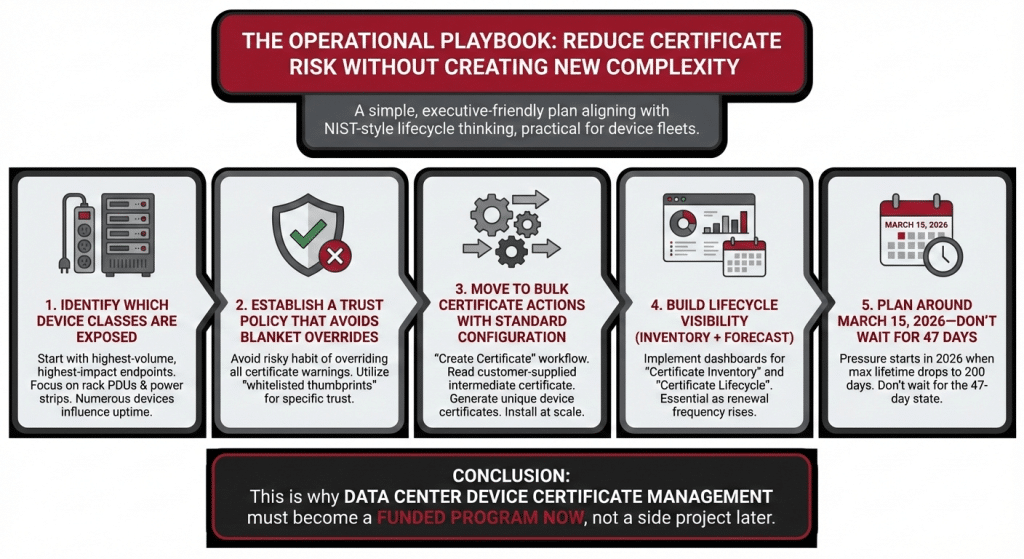
Here is a simple, executive-friendly plan that aligns with NIST-style lifecycle thinking while staying practical for device fleets.
Step 1: Identify which device classes are exposed
Start with the highest-volume, highest-impact endpoints—typically rack PDUs and power strips—because they are numerous and can influence uptime.
Step 2: Establish a trust policy that avoids blanket overrides
Your deck’s “whitelisted thumbprints” concept is important because it avoids the risky habit of overriding all certificate warnings.
Step 3: Move to bulk certificate actions with standard configuration
The deck’s “Create Certificate” workflow describes reading from a customer-supplied intermediate certificate, generating unique device certificates, and installing them at scale.
Step 4: Build lifecycle visibility (inventory + forecast)
Your roadmap section proposes dashboards such as “Certificate Inventory” and “Certificate Lifecycle,” which are exactly what operators need as renewal frequency rises.
Step 5: Plan around March 15, 2026—don’t wait for 47 days
The 47-day state feels far away, but the pressure starts in 2026 when max lifetime drops to 200 days.
This is why data center device certificate management must become a funded program now, not a side project later.
The clock is already running toward March 15, 2026. When TLS lifetimes drop to 200 days, every manual certificate step becomes a repeating tax. When lifetimes fall to 47 days, manual work becomes a reliability risk.
If you manage intelligent PDUs or other critical devices, treat data center device certificate management as a security and uptime initiative—not just a PKI detail.
Take the next step now: review the solution and start mapping your device fleet to an automated lifecycle approach at https://www.nlyte.com/products/device-management/ or Request Demo to see Nlyte Device Management in Action.
Additional Resources on this topic
CA/Browser Forum – Ballot SC081v3 (primary source)
Confirms the adopted schedule and voting outcome behind reduced validity and data reuse periods. CA/Browser Forum Ballot SC081v3
DigiCert – “TLS Certificate Lifetimes Will Officially Reduce to 47 Days” (May 2025)
Explains the staged timeline and why automation becomes essential, with a clear schedule summary. DigiCert explainer
Data Center Dynamics – “The advances in rack PDU firmware…” (Jan 2024)
Highlights why intelligent PDU capabilities matter for rack operations and monitoring discipline. DCD article
Uptime Institute – “Renewable energy for data centers”
Strong operator framing on RECs vs PPAs and the risk of greenwashing without a credible portfolio. Uptime report
Google – “Moving toward 24x7 Carbon-Free Energy at Google Data Centers”
Provides a practical framework for evaluating 24/7 matching beyond annual renewable claims. Google 24/7 CFE report
Microsoft – “6 projects that helped Microsoft meet its renewable energy goal” (Feb 2026)
Explains how procurement scale and PPAs help bring renewable projects online to serve data center demand. Microsoft Source story