
Master Your Assets: Nlyte ServiceNow CMDB Integration
Published on December 17, 2025,
by

Bridging the Gap with Nlyte ServiceNow CMDB Integration
In the modern data center, the concept of a "Single Source of Truth" is often more of an aspiration than a reality. IT teams rely heavily on IT Service Management (ITSM) platforms like ServiceNow to manage the logical layer of their infrastructure. Meanwhile, Facilities and Data Center Operations teams utilize Data Center Infrastructure Management (DCIM) tools like Nlyte to manage the physical layer: power, cooling, space, and cabling.
When these two worlds remain separate, data silos emerge. The logical view doesn’t match the physical reality, leading to ghost servers, stranded capacity, and compliance nightmares.
This is where the power of the Nlyte ServiceNow CMDB integration comes into play. By harmonizing these two critical systems, organizations can achieve a level of transparency and operational excellence that was previously out of reach.
The Challenge of Disconnected Data
Before diving into the solution, it is essential to understand the friction caused by disconnected systems. Typically, ServiceNow excels at maintaining asset attributes—knowing what you own (financial data, service mapping, software dependencies). However, it often lacks the granular detail of where exactly that asset resides within the physical infrastructure.
Does the Service Desk know that the server causing an alert is located in Rack 4, U-position 12, in the New York facility? Do they know it is connected to a specific PDU that is nearing capacity? Without integration, this data is missing or requires a manual "swivel chair" process—logging out of one system and into another—to find the answer.
This disconnect leads to:
- Redundant Data Entry: Typing the same serial number into two systems increases the risk of human error by 50%.
- Slow Audit Response: extensive man-hours spent walking the floor to verify assets.
- Inefficient Change Management: Technicians arriving at the wrong cabinet or lacking the power capacity to deploy new gear.
The Solution: A Unified View of Physical and Logical Assets
The Nlyte ServiceNow CMDB integration solves these challenges by enabling the bi-directional sharing of asset information. It bridges the gap between the logical configuration items (CIs) in the CMDB and the physical assets managed in Nlyte.
This is not just a one-time dump of data; it is a synchronization of the lifecycle of your assets.
By integrating physical asset data directly into the ServiceNow CMDB, Nlyte provides a comprehensive view that includes:
- Precise Locations: Down to the specific Cabinet and Rack Unit (U) level.
- Relationships: Understanding upstream and downstream dependencies.
- Hardware Specifications: Detailed chassis mounting and physical attributes.
While ServiceNow continues to act as the master for asset/data attributes, Nlyte takes the lead on managing location details. This division of labor ensures that both systems are playing to their strengths while sharing a unified dataset.
Deep Dive: What Actually Synchronizes?
For an integration to be valuable, the data exchange must be robust. The Nlyte ServiceNow CMDB integration facilitates the synchronization of critical data points that operations teams use daily.
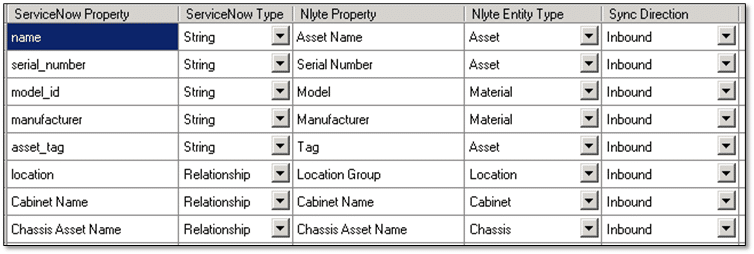
Key synchronized attributes include:
- Identification: Asset Name, Serial Number, and Asset Tags.
- Hardware Details: Manufacturer and Model information.
- Deployment Data: Exact Location, Cabinet ID, and Chassis Mounting position.
- Custom Fields: The integration is flexible enough to handle organization-specific data via the Nlyte API, such as Purchase Order (PO) numbers or RFID Tag data.
This level of detail means that when an IT manager looks at a service map in ServiceNow, they aren't just seeing a logical icon; they are seeing a representation of a physical device with a validated location.
Revolutionizing the Change Management Process
One of the most immediate impacts of deploying the Nlyte ServiceNow CMDB integration is seen in the Change Management workflow.
In a non-integrated environment, a request to decommission a server involves multiple tickets and emails between IT and Facilities. With integration, the process is streamlined.
Empowering Teams with Transparency
The integration empowers change management teams with better control. When a change request is initiated in ServiceNow, the physical feasibility can be instantly verified against Nlyte’s data. Is there space? Is there power?
Reducing Deployment Time
Because the "where" is automatically populated, technicians spend less time searching for open rack space and more time deploying. The integration reduces deployment and decommissioning time significantly by removing the guesswork.
Minimizing Redundancy
Perhaps most importantly, this seamless integration minimizes redundant data entry. When a change is made in the physical world (e.g., a server is racked), Nlyte updates ServiceNow. When a logical change is made (e.g., an asset is retired), ServiceNow can trigger a workflow for physical removal. This seamlessly integrates change requests for physical assets into ServiceNow workflows, increasing overall process accuracy.
Operational Excellence and Risk Reduction
Beyond the day-to-day workflows, the Nlyte ServiceNow CMDB integration drives long-term operational excellence.
Enhancing Efficiency and Accuracy
Efficiency is gained by eliminating manual reconciliation spreadsheets. When the CMDB is accurate, operations teams trust the data. This improves accuracy not just for daily operations, but for critical audits and compliance reporting. You no longer have to fear the auditor’s clipboard; you have the data ready at your fingertips.
Lowering Costs and Risks
Facilities costs are substantial. By having an accurate view of capacity through the integration, organizations can delay building new data centers by better utilizing existing space. Furthermore, the integration lowers the risk of outages. By understanding the physical dependencies of logical services, teams can avoid overloading power strips or creating hot spots that could lead to downtime.
Managing Remote Sites
In the age of Edge computing, managing remote sites is a growing challenge. The integration enables the management of more resources in less time, extending visibility to remote sites where IT presence might be minimal. You can manage assets in a colocation facility or an edge closet with the same rigor as your core enterprise data center.
Conclusion: The Value of Connected Systems
In today's complex IT environment, you cannot afford to have your Facilities team and your IT Service Management team speaking different languages. The Nlyte ServiceNow CMDB integration acts as the universal translator, enhancing information flow and change control across departments.
By synchronizing these two powerful platforms, organizations accelerate audit responses, reduce operational costs, and improve overall IT operational efficiency. It moves the organization away from reactive firefighting and toward proactive, optimized asset lifecycle management.
If you are looking to gain complete control over your IT assets from the rack to the report, bridging the divide with Nlyte and ServiceNow is the logical and physical is the next step.
 |
Are you ready to Bridge the Gaps in Your Physical Infrastructure Data with Nlyte for ServiceNow® ITSMMany organizations face challenges such as unreliable CMDB Configuration Items (CIs), lack These issues are more than just inconveniences. They can lead to serious downstream impacts, including:
Nlyte for ServiceNow® ITSM helps eliminate these blind spots by delivering real-time, accurate insights into your physical infrastructure—empowering better decisions, streamlined operations, and a more complete CMDB. Learn more: Nlyte for ServiceNow® ITSM | Nlyte
|
