
ServiceNow DCIM Integration: Closing the Loop Between Logical Incidents and Physical Impact
Published on January 6, 2026,
by


It is 3:00 AM. The pager goes off. A critical financial application has degraded, and latency is spiking. The IT Operations lead opens a ticket in ServiceNow. The dashboard is clear: "Server DB-04 is unresponsive."
You know what broke. You know who owns it, what service level agreement (SLA) is at risk, and the cost center associated with it.
But do you know where it is?
Not just which building or room, but which specific cabinet? Which U-position? Is it plugged into PDU-A or PDU-B? Is the cooling unit serving that specific row functioning correctly?
For many organizations, this is where the trail goes cold. This is the "air gap" between IT Service Management (ITSM) and Data Center Infrastructure Management (DCIM). Bridging this gap is no longer just a convenience; it is a necessity for operational resilience. This article explores how a robust ServiceNow DCIM integration using Nlyte closes the loop between logical incidents and physical reality, drastically shrinking Mean Time to Resolution (MTTR).
The Tale of Two Domains
To understand the solution, we must first acknowledge the divide. In most enterprises, IT Operations and Facilities Management operate in silos, utilizing different languages and different tools.
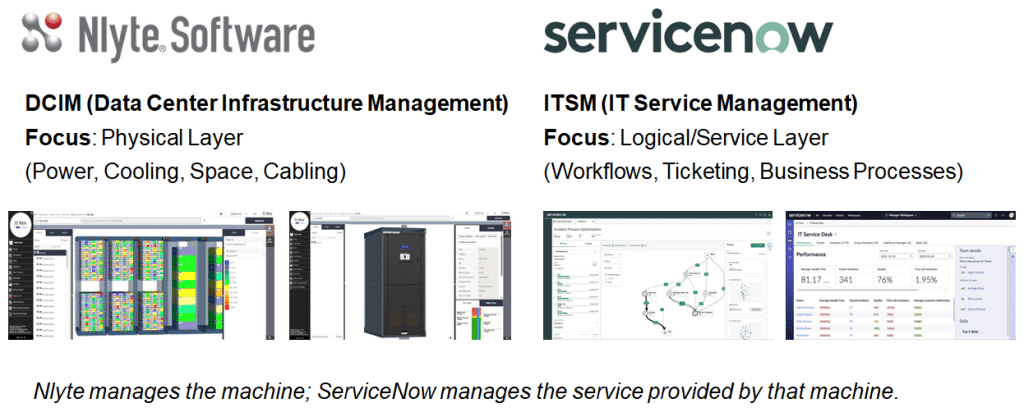
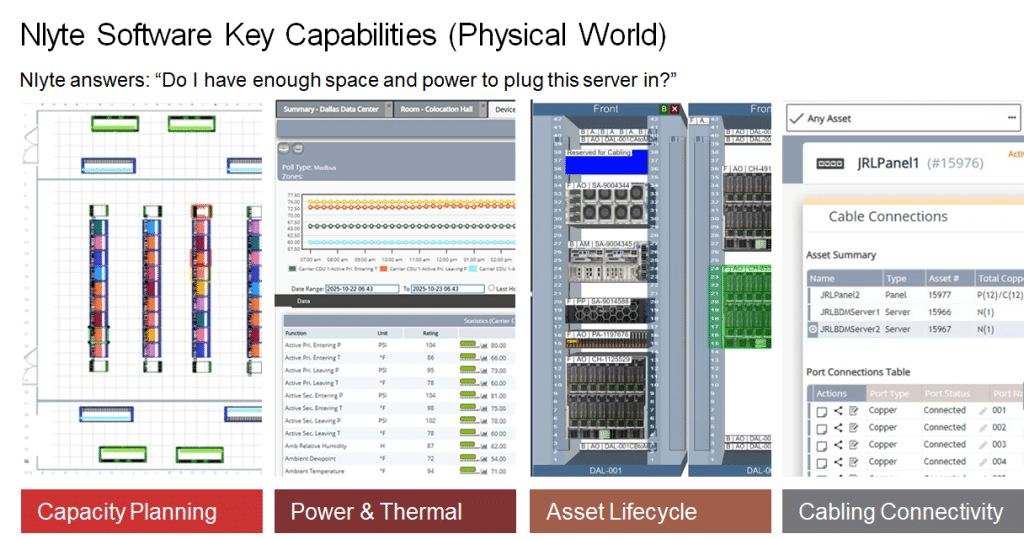
ServiceNow (The Logical World):
This is the domain of the Service Desk and the CIO. Here, the focus is on the "Service." The CMDB (Configuration Management Database) tracks ownership, warranty status, cost centers, and software dependencies. It answers the question: "Who relies on this asset?"
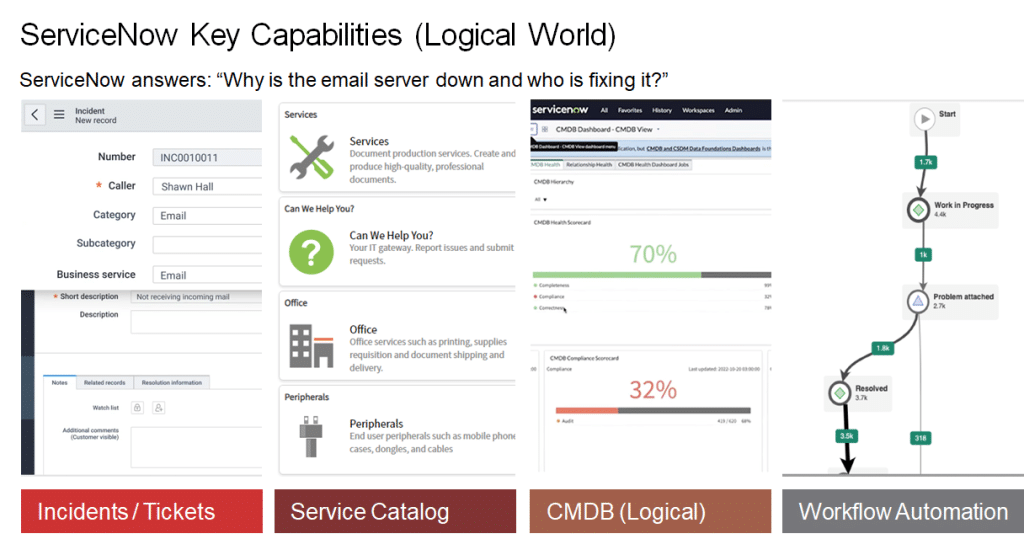
Nlyte (The Physical World):
This is the domain of the Data Center Manager. Here, the focus is on the "Infrastructure." Nlyte tracks rack elevations, power draw, cabling, weight, and cooling zones. It answers the question: "Where is this asset physically located, and is it safe?"
Without a ServiceNow DCIM integration, these two worlds never meet. When a change request is made in ServiceNow to decommission a server, the facilities team might not receive the work order for days. Conversely, if a breaker trips, the IT team sees servers go offline but lacks the context to know it’s a power chain issue, leading to wasted time troubleshooting software.
A Real-World Incident: The Integrated Workflow
Let’s rewind to our 3:00 AM scenario. This time, however, the organization has implemented a bidirectional synchronization between Nlyte and ServiceNow. Here is how the narrative changes.

1. The Alert (Logical Trigger)
The monitoring system detects latency on the financial application. A ticket is automatically generated in ServiceNow. Because the asset records are synced, the ticket for "Server DB-04" includes a direct link to its physical profile in Nlyte.
2. The Investigation (Physical Context)
Instead of dispatching a technician to "search the floor," the System Reliability Engineer (SRE) clicks the Nlyte link within the ServiceNow ticket.
Instantly, they are presented with a rack elevation view. They see that Server DB-04 is located in the Atlanta Facility, Room B, Row 4, Rack 12, U-positions 10-14. More importantly, the ServiceNow DCIM integration allows them to overlay real-time environmental data. They notice that the temperature sensors at the top of Rack 12 are flashing red.
3. Root Cause Identification
The SRE zooms out in Nlyte to see the floor plan. They identify that the CRAC (Computer Room Air Conditioning) unit responsible for Row 4 is currently in a maintenance cycle. The server hasn't crashed due to a software bug; it is thermal throttling to protect its CPU.
4. The Fix and Post-Mortem
The SRE contacts the Facilities team immediately, identifying the specific cooling unit. They also use the CMDB data to identify a backup server in a different cooling zone and migrate the workload. The service is restored in minutes, not hours.
Without the integration, the IT team would likely still be analyzing log files, unaware that the problem was physical.
How the Synchronization Works
The magic lies in the data mapping. A successful ServiceNow DCIM integration isn't just about dumping data from one bucket to another; it's about intelligent synchronization.
Nlyte acts as the source of truth for physical attributes, pushing the following data into the ServiceNow CMDB:
- Granular Location: Beyond just "Site," it syncs the specific Cabinet, Chassis, and U-Position.
- Asset Identity: Serial numbers, Asset Tags, Manufacturers, and Models are validated physically before entering the CMDB.
- Power Connectivity: Mapping which power strip outlets connect to which server power supplies.
Conversely, ServiceNow pushes logical data back to Nlyte:
- Ownership: Who owns the asset?
- Service Association: Which business application does this server support?
- Status: Is this asset in production, maintenance, or retired?
This bidirectional flow ensures that when a Data Center Manager looks at a rack in Nlyte, they know who to call if they need to power it down.
Transforming Change Management
Beyond incident response, the most significant ROI of ServiceNow DCIM integration comes from Change Management.
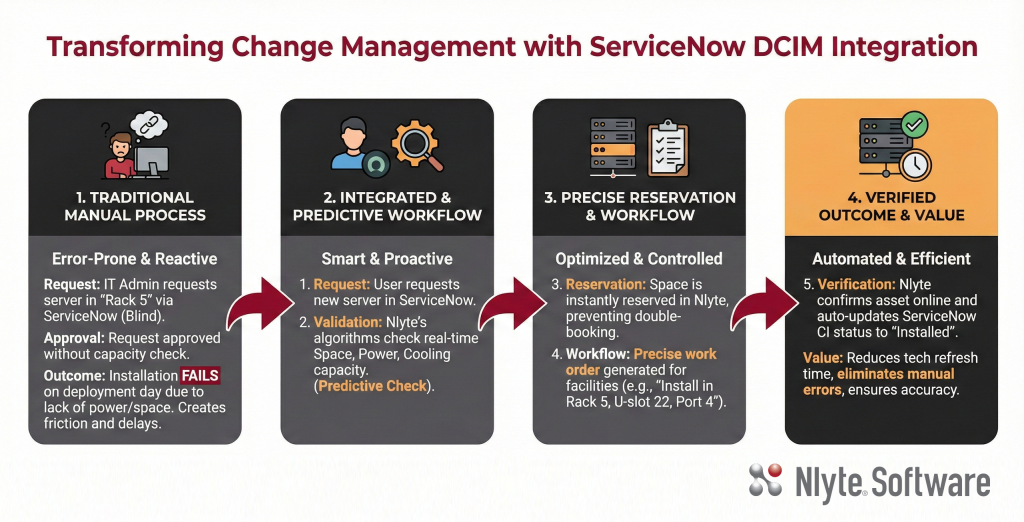
In a non-integrated environment, "Move, Add, Change" (MAC) processes are prone to error. An IT Admin might request a new server deployment in "Rack 5" via ServiceNow, unaware that Rack 5 is out of power capacity. The request gets approved, hardware is ordered, and the installation fails on the day of deployment.
With Nlyte integrated into the workflow, the process becomes predictive:
- Request: A user requests a new server in ServiceNow.
- Validation: Nlyte’s specialized algorithms check for space, power, and cooling capacity in real-time.
- Reservation: The space is reserved in Nlyte, preventing "stranded capacity" or double-booking.
- Workflow: The work order is generated for the facilities team with precise installation instructions (e.g., "Install in Rack 5, U-slot 22, Connect to PDU A, Port 4").
- Verification: Once installed, Nlyte confirms the asset is online and updates the ServiceNow CI (Configuration Item) status to "Installed."
This reduces the time required for tech refresh planning and eliminates the friction of manual data entry errors.
Operational Excellence and Audit Readiness
The modern data center is subject to increasing regulatory scrutiny. Whether it is SOC2, HIPAA, or ISO standards, auditors want to know exactly where your data lives and who has access to it.
A manual audit is a grueling process of walking the floor with a clipboard and a barcode scanner, hoping the spreadsheet matches the rack. It is costly, slow, and prone to human error.
With ServiceNow DCIM integration, the audit is essentially continuous. Because the physical moves on the floor are tied to the logical changes in the CMDB, the repository remains accurate. You can generate reports that correlate specific hard drives to business services instantly. This capability accelerates audit response times and significantly reduces the operational costs associated with compliance.
Conclusion
The distinction between "IT" and "Facilities" is becoming increasingly blurred. As infrastructure becomes more complex and service expectations rise, the inability to correlate a logical service to a physical asset is a risk no organization should accept.
By implementing a ServiceNow DCIM integration, you are doing more than just connecting two databases. You are empowering your Change Management teams with transparency. You are giving your Incident Response teams X-ray vision. You are ensuring that when the pager goes off at 3:00 AM, your team has the answers they need to keep the lights, and the business, running.
 |
Ready to Bridge the Gap?Don't let your physical assets be a blind spot in your service delivery. Download the Nlyte for ServiceNow® ITSM guide to learn how Nlyte can synchronize your infrastructure and streamline your operations today. |
