
Top 3 Physical Resources That Have the Biggest Impact on Data Center Costs
Published on December 9, 2025,
by

Modern data centers are scaling fast to meet AI, cloud, and hybrid workloads. As a result, physical resources such as power, cooling, and floor space now have a major impact on both OpEx and CapEx. Although operators have achieved some efficiency gains, industry data shows that PUE improvements have plateaued. Rack densities also remain modest across most facilities. This trend reinforces why careful resource management is critical for real savings.
With compute intensity continuing to rise, it is essential to optimize these three factors together. In addition, as densities increase for AI workloads, thermal strategies must adapt. Traditional air cooling is no longer enough. Therefore, monitoring and design should evolve toward liquid-ready architectures in suitable zones to maintain efficiency and resilience.
1.Power: The Primary Cost Driver
Why it matters: Electricity is the largest ongoing expense in most facilities. As compute demand rises, power availability, procurement strategy, and distribution efficiency directly affect total cost of ownership (TCO). At the same time, many operators report flat average PUE and gradually rising rack densities (still below ~8 kW on average), a sign that efficiency gains from basic measures have already been captured and further improvement will require deeper changes in design and operations.
What to do next:
- Measure relentlessly. Track live IT load, facility load, and PUE at meaningful granularity; use DCIM/BMS to correlate workload placement with energy use. This helps identify stranded capacity and inefficient circuits.
- Plan for density. As certain workloads trend upward in kW per rack, ensure upstream power (UPS, PDUs, feeders) and downstream cooling are sized for those profiles, not historical averages.
- Procure intelligently. Align tariff structures and renewable contracts with utilization profiles to reduce volatility and support sustainability reporting. Nlyte’s Sustainability solution provides the tools to track energy usage, carbon emissions, and compliance metrics accurately. With disciplined metering and automated reporting, organizations gain operational transparency and meet regulatory requirements while advancing their environmental goals.
2.Cooling: Where Efficiency Gains Are Won (or Lost)
Why it matters: Cooling is the largest nonIT load and becomes more complex as densities climb. For many AI and HPC deployments, traditional air cooling alone will not sustain thermal stability at higher power densities, pushing operators toward liquidready architectures, such as reardoor heat exchangers or directtochip cold plates, within targeted zones.
What to do next:
- Adopt liquid ready designs where densities warrant. Industry reports highlight that workloads exceeding 50 kW per rack increasingly require liquid cooling to maintain efficiency and uptime. Treat these systems as part of an integrated thermal chain, including CDUs, pumps, and control logic, all tied into monitoring platforms.
- Tighten airflow management. For areas that remain air-cooled, optimize containment and airflow paths. Adjust supply and return routes and use part-load controls to prevent bypass air and reduce fan energy waste. Pair these measures with granular sensors to modulate cooling equipment based on actual load.
- Coordinate with power planning. Cooling strategies should align with power density plans to avoid hotspots and stranded capacity. Integrating thermal telemetry with workload orchestration can reduce energy use and minimize risk.
3.Floor Space: Finite, Expensive, and Often Underutilized
Why it matters: Space constraints significantly influence both short-term operational costs and long-term growth strategies. As rack densities increase unevenly across the data center, layouts must adapt to prevent stranded power and cooling capacity. Without proper planning, inefficiencies can spread quickly, impacting energy use, performance, and overall scalability.
Therefore, optimizing placement and utilization becomes a strategic imperative. By designing flexible layouts and leveraging accurate asset data, operators can unlock hidden capacity. This approach helps delay costly expansions while maintaining service levels and resilience. In addition, forward-thinking space management ensures every square foot delivers maximum value in an era of accelerating compute demand.
What to do next:
- Design for modularity. Use standardized blocks that can accept higherdensity pods with appropriate power/cooling corridors, rather than retrofitting entire rooms at once.
- Maximize utilization with accurate asset data. DCIMdriven capacity maps reveal idle racks, ghost loads, and uneven heat signatures, enabling consolidation that frees space and reduces energy.
- Align space with workload tiers. Group latencysensitive or AIdense workloads near liquidready zones; reserve aircooled rows for lighter profiles to keep overall economics balanced.
How DCIM Reduces Cost Across Power, Cooling, and Space
Managing power, cooling, and space effectively demands a unified approach. Nlyte DCIM delivers that single source of truth, connecting energy telemetry, IT asset data, capacity planning, and operational workflows into one intelligent platform.
This integrated view empowers operators to:
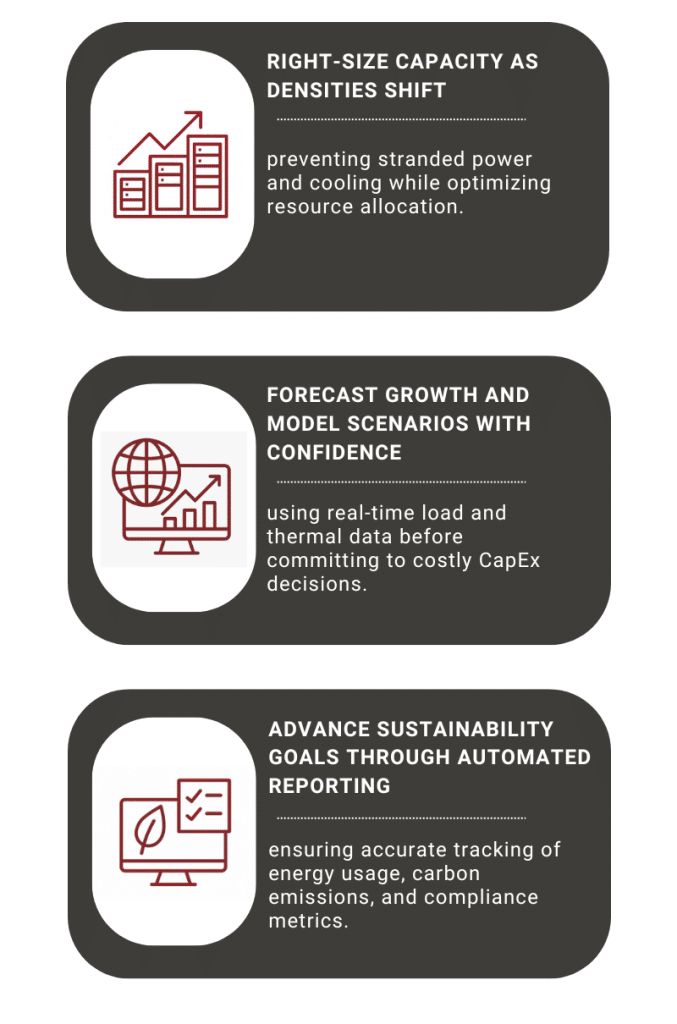
By leveraging Nlyte DCIM, organizations move beyond reactive management to proactive optimization, reducing costs, improving resilience, and aligning operations with long-term business and environmental objectives.
Conclusion: Treat the Big Three as One System
To lower data center costs sustainably, treat power, cooling, and floor space as one interconnected system. Measurement and governance must be at the core of this strategy.
Start by improving metering and telemetry to gain accurate visibility. Then, plan densification carefully to avoid stranded capacity and unnecessary expansion. As AI and HPC workloads grow, adopt advanced cooling methods where traditional air systems fall short.
Finally, integrate these efforts with a robust DCIM platform. This enables real-time insights, predictive modeling, and automated reporting. Together, these steps enhance efficiency, strengthen resilience, and deliver long-term cost control.
