Why Data Center Infrastructure Management (DCIM) is Critical for Healthcare
Published on January 7, 2026,
by

Modern healthcare is in the midst of a radical digital transformation. From the comprehensive Electronic Health Records (EHR) that track patient history to the Picture Archiving and Communication Systems (PACS) that manage medical imaging, technology is no longer just a support function—it is the foundation of patient care.
However, this reliance on digital infrastructure creates a unique pressure cooker for IT leaders. Healthcare data centers must manage massive data growth while navigating strict regulations, cybersecurity threats, and the absolute necessity of keeping systems running 24/7.
To meet these intersecting challenges, organizations are increasingly turning to Data Center Infrastructure Management (DCIM). DCIM for healthcare is no longer a luxury; it is a critical discipline required to ensure operational resilience, data security, and compliance.
In this post, we will explore the high-stakes environment of healthcare IT and how DCIM provides the visibility and control needed to succeed.
The Unique Stakes of Healthcare IT
Unlike other industries where downtime simply means lost revenue, in healthcare, IT failures can compromise patient safety. A delay in accessing a digital medication list or a diagnostic image because a server overheated can have life-threatening consequences.
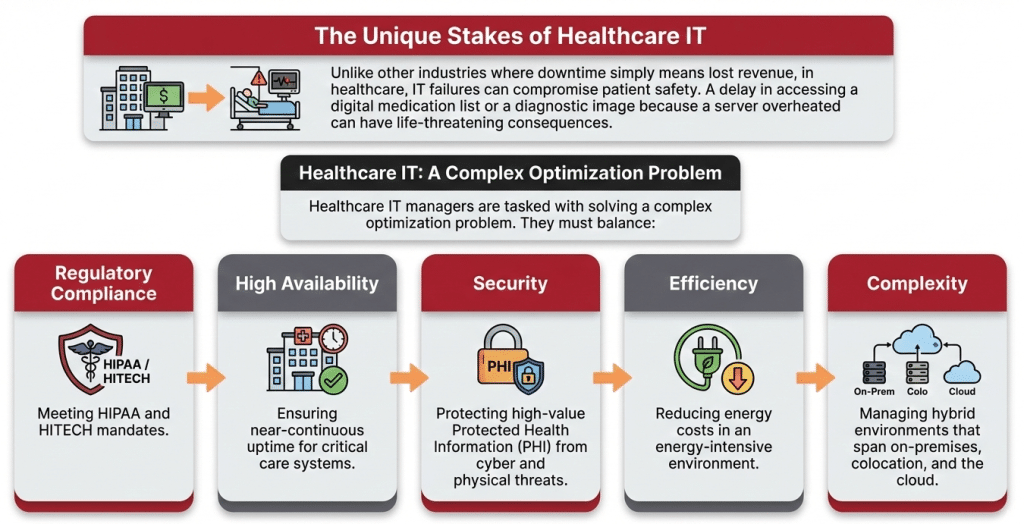
Healthcare IT managers are tasked with solving a complex optimization problem. They must balance:
- Regulatory Compliance: Meeting HIPAA and HITECH mandates.
- High Availability: ensuring near-continuous uptime for critical care systems.
- Security: Protecting high-value Protected Health Information (PHI) from cyber and physical threats.
- Efficiency: Reducing energy costs in an energy-intensive environment.
- Complexity: Managing hybrid environments that span on-premises, colocation, and the cloud.
Addressing any one of these challenges in a silo often worsens another. For example, increasing redundancy to ensure uptime increases complexity and energy usage. This is where a holistic management approach becomes essential.
1. Simplifying HIPAA Compliance and Audit Readiness
Perhaps the most defining characteristic of the sector is the weight of regulatory compliance. The HIPAA Security Rule mandates rigorous administrative, physical, and technical safeguards to protect patient data.
Achieving compliance is difficult when relying on manual spreadsheets or fragmented tools. DCIM for healthcare provides a centralized "single source of truth" that simplifies this process significantly.
Asset Inventory as a Foundation for Risk Analysis
HIPAA requires regular risk analyses to identify where electronic Protected Health Information (ePHI) resides and how it is protected. DCIM automates asset management, maintaining a detailed inventory of every server, storage array, and network switch. This allows IT teams to pinpoint exactly which physical assets contain patient data, creating the foundation for an accurate risk assessment.
Automated Audit Trails
The ability to prove who did what, and when, is vital during an audit. DCIM systems generate automated logs for infrastructure changes and physical access events. By integrating with security systems, DCIM can show exactly who accessed a server rack containing sensitive data, satisfying HIPAA’s physical safeguard requirements.
2. Ensuring High Availability for Patient Care
In a hospital, "five nines" of availability (99.999% uptime) is not just a metric; it is a clinical necessity.
DCIM platforms play a vital role in preventing outages through real-time monitoring and predictive analytics. By continuously tracking power loads, UPS status, and environmental conditions, DCIM alerts staff to anomalies before they escalate into failures.
Furthermore, capacity planning features allow managers to perform "what-if" scenarios. Before deploying new imaging servers, an IT manager can simulate the impact on power and cooling capacity, ensuring that the new load won’t trip a breaker and take down critical systems. This proactive approach shifts data center management from reactive firefighting to predictive prevention.
3. Strengthening Physical and Cyber Security
While cybersecurity often grabs the headlines, physical security is equally critical. Unauthorized physical access to a server allows bad actors to bypass firewalls and steal data or introduce malicious hardware.
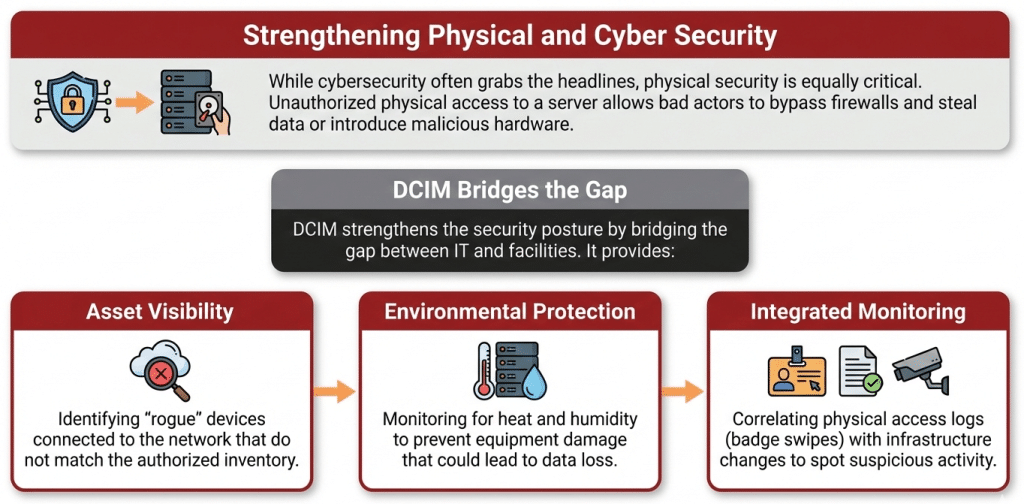
DCIM strengthens the security posture by bridging the gap between IT and facilities. It provides:
- Asset Visibility: Identifying "rogue" devices connected to the network that do not match the authorized inventory.
- Environmental Protection: Monitoring for heat and humidity to prevent equipment damage that could lead to data loss.
- Integrated Monitoring: correlating physical access logs (badge swipes) with infrastructure changes to spot suspicious activity.
4. Driving Energy Efficiency in a Cost-Conscious Era
Hospitals operate on slim margins, yet data centers are massive energy consumers—using up to 50 times the energy per floor space of a typical office building.
Implementing DCIM for healthcare facilities offers a direct path to reducing Operational Expenditures (OpEx). By calculating Power Usage Effectiveness (PUE) and identifying "comatose" servers (equipment that consumes power but performs no useful work), DCIM helps organizations reclaim energy capacity.
Additionally, environmental monitoring allows facilities to optimize cooling. Instead of over-cooling the entire room, managers can use thermal mapping to identify hot spots and deliver cooling only where it is needed. This not only lowers utility bills but also aligns with corporate sustainability goals.
5. Managing the Complexity of Hybrid Infrastructure
Healthcare environments are rarely homogenous. They typically involve a mix of legacy applications, modern on-premises systems, and cloud services.
DCIM provides a "single pane of glass" visibility across this hybrid landscape. Whether the asset is in the hospital basement or a remote edge site, DCIM centralizes the data, breaking down the traditional silos between IT and Facilities teams. This collaboration is crucial for planning capacity and ensuring that power and space are available for future growth.
How Nlyte Software Empowers Healthcare
Choosing the right partner is essential. Nlyte Software offers a comprehensive DCIM suite designed specifically for the rigorous demands of regulated industries like healthcare.
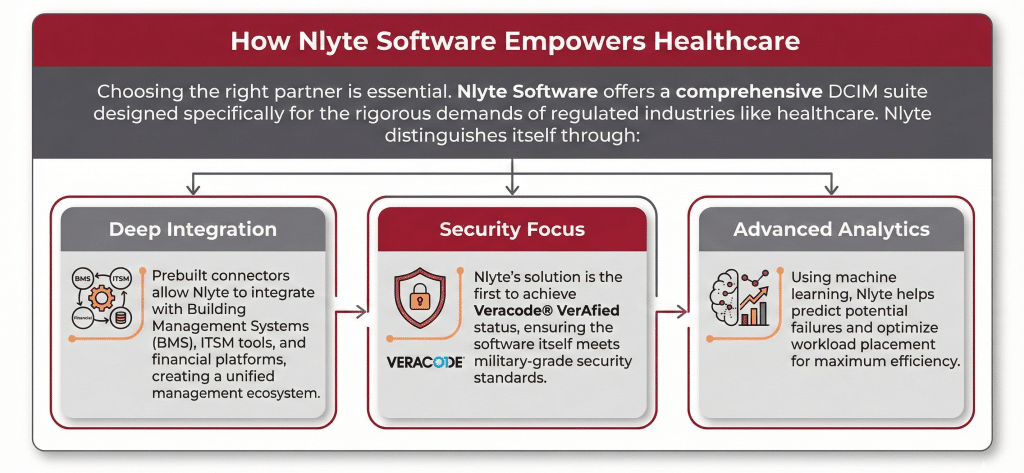
Nlyte distinguishes itself through:
- Deep Integration: Prebuilt connectors allow Nlyte to integrate with Building Management Systems (BMS), ITSM tools, and financial platforms, creating a unified management ecosystem.
- Security Focus: Nlyte’s solution is the first to achieve Veracode® VerAfied status, ensuring the software itself meets military-grade security standards.
- Advanced Analytics: Using machine learning, Nlyte helps predict potential failures and optimize workload placement for maximum efficiency.
Leading healthcare providers have utilized Nlyte to track assets across regulatory boundaries, defer costly capital expenditures by reclaiming stranded capacity, and ensure the continuous availability of critical patient services.
Conclusion
The data center is the operational heart of modern healthcare. To keep it beating strong, organizations must move beyond manual spreadsheets and reactive maintenance.
DCIM for healthcare transforms infrastructure management into a proactive, automated, and secure discipline. It enables IT leaders to maintain compliance, protect patient data, and ensure that life-saving technology is always available when clinicians need it most.
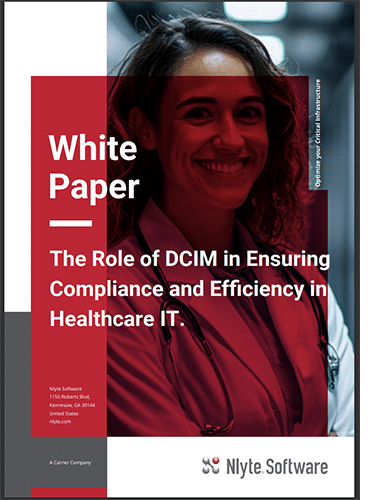 |
Ready to dive deeper into the strategies for optimizing your healthcare IT infrastructure?
|