
Why Workload Asset Management Is the Key to Optimizing Modern Data Center Performance
Published on June 17, 2026,
by

Data centers are defined by the applications, services, and digital experiences they deliver, powered by the seamless integration of infrastructure and workloads. When these elements are aligned, organizations can achieve greater efficiency, optimize costs, and enhance overall performance.
Workload asset management introduces a more intelligent, connected approach aligning IT applications with the physical and virtual assets that support them to enable smarter, more informed decision-making across the entire environment.
What Is Workload Asset Management?
Workload asset management brings together applications and the infrastructure required to run them, spanning compute, storage, network, power, and cooling resources. Rather than viewing these elements in isolation, it creates a unified perspective that links workloads directly to the assets that sustain them.
This approach enables organizations to:
- Improve visibility across distributed, hybrid, and edge environments
- Understand how infrastructure conditions impact application performance
- Allocate resources more effectively based on real-time constraints
- Support consistent uptime and operational efficiency
By shifting the focus from infrastructure alone to the outcomes it enables, organizations can make more strategic decisions that better support business priorities.
The Challenge: Complexity at Scale
Modern data center environments are becoming increasingly dynamic. Hybrid architectures, AI-driven workloads, and distributed edge deployments are introducing new layers of complexity.
Industry research highlights that operators are navigating growing challenges around cost control, capacity planning, and energy efficiency, while also adapting to unpredictable workload demands and increasing power constraints.
At the same time, the need for real-time visibility across assets, power, cooling, and capacity has become critical to maintaining efficiency and preventing disruption.
Without that visibility and alignment, organizations can experience:
- Unused or underutilized capacity
- Performance bottlenecks in high-demand environments
- Rising operational spend
- Increased exposure to risk
From Reactive Operations to Intelligent Optimization
Traditional data center operations have often relied on reactive processes, responding to issues after they arise. While this approach has supported past environments, it is less suited to today’s speed and scale of change.
Workload asset management enables a more proactive operating model by combining real-time data with analytics-driven insights. This allows organizations to:
- Anticipate capacity and performance requirements earlier
- Align workloads with available infrastructure resources dynamically
- Identify dependencies and potential risks across systems
- Continuously optimize operations as conditions evolve
As a result, infrastructure becomes more adaptive, enabling greater agility and more consistent service delivery.
Bridging the Gap Between IT and Facilities
A long-standing challenge in data center operations is the separation between IT teams and facilities teams. Each group often works with different data sets, tools, and priorities.
Workload asset management brings these perspectives together by creating a shared, unified view of operations. By linking infrastructure performance directly to application outcomes, organizations can:
- Improve collaboration across teams
- Enable faster, more informed decision-making
- Strengthen alignment between operational and business goals
This integrated approach builds on the foundations of DCIM, extending visibility beyond infrastructure into the applications that drive value.
Why It Matters Now: Adapting to AI, Edge, and Hybrid IT
Workload behavior is evolving rapidly, as the adoption of AI continues to expand and IT environments become increasingly distributed. As a result, infrastructure is being shaped by new and more dynamic demands that require greater flexibility and responsiveness.
At the same time, industry insights show that more organizations are deploying AI workloads. Consequently, higher power densities are being introduced, and demand is becoming more variable. In turn, infrastructure planning is becoming more complex and requires a more informed approach.
Therefore, in this evolving landscape, planning models are becoming more advanced and responsive. As a result, organizations are embracing data-driven strategies that adapt in real time, ensuring workloads are continuously supported by the most suitable infrastructure conditions.
How Nlyte Supports Workload Asset Management
Nlyte enables organizations to operationalize workload asset management through a unified platform that connects infrastructure, assets, and applications across the enterprise.
By integrating DCIM capabilities with advanced analytics and automation, Nlyte helps organizations:
- Optimize workload placement based on power, space, and cooling availability
- Gain a consolidated view across physical and virtual environments
- Improve decision-making through data-driven insights
- Streamline asset lifecycle management from deployment to decommissioning
- Support compliance, sustainability, and operational reporting requirements
This approach reduces manual effort while enhancing visibility, efficiency, and overall performance across the data center ecosystem.
Key Benefits of a Workload-Centric Approach
Adopting workload asset management delivers meaningful advantages across operations:
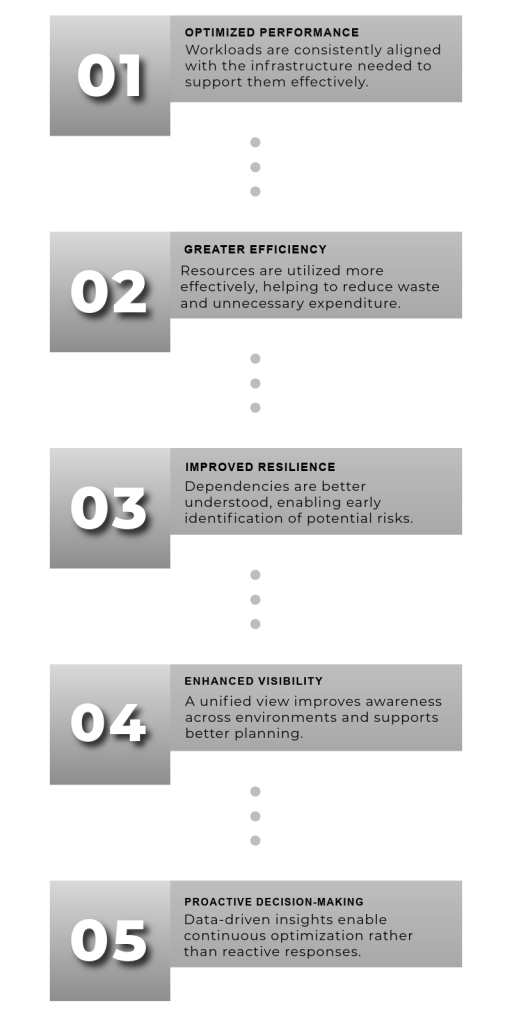
Optimizing for the Future of Digital Infrastructure
Data centers are designed to deliver the applications and services that power modern businesses. By adopting a workload-centric approach, organizations can align infrastructure with application needs, creating more efficient, resilient, and high-performing environments.
Solutions such as Nlyte further enhance this approach by providing the visibility, intelligence, and automation needed to continuously optimize workload performance across the entire data center ecosystem.
Ready to see how a workload-centric approach can transform your data center operations? Request a demo to experience how intelligent workload asset management can optimize performance, improve efficiency, and drive better outcomes across your infrastructure.


Request a Demo Today