Beyond Custom Code: Why Connector Frameworks Lower Integration TCO
Published on January 28, 2026,
by

Custom integrations may seem cost‑effective at first, but their true expense appears over time. As APIs change and security requirements tighten, maintaining bespoke code becomes harder and more expensive. Operational demands also grow, adding to the burden. For enterprise architects and IT operations leaders, the real question is how reliably and sustainably these integrations can be maintained. This is where connector frameworks change the economics of integration and significantly lower total cost of ownership.
The hidden math of integration TCO
When teams choose custom code, they often compare only initial build hours versus a license line item. But the integration of TCO is dominated by maintenance, monitoring, and risk. Here’s where costs creep in:
- Version drift & deprecations: Pre-built Nlyte connectors are vendor-supported and designed to keep pace with common CMDBs (ServiceNow, BMC, Ivanti, Cherwell) and hypervisors (VMware, HyperV, Nutanix, Citrix), reducing rework.
- Operational fragility:
Homegrown scripts often lack strong error handling and end‑to‑end health checks. As a result, failures appear only when tickets build up or data falls out of sync. In addition, these scripts rarely offer clear visibility across systems. This is why Nlyte’s connector frameworks focus on supported integration. They break down silos, improve transparency, and strengthen alignment between DCIM and the service desk.
- Security upkeep:
As identity and access controls evolve, custom code must be updated to maintain secure authentication and proper auditability. As a result, teams often spend time retrofitting scripts to keep pace with new security policies. In addition, these changes can introduce new risks when credentials are handled inconsistently. This is why Nlyte’s connectors and products expose secure REST APIs. They are engineered to interface safely with adjacent systems and reduce the need for ad hoc credential handling.
- People dependency risk: Bespoke scripts concentrate knowledge in a few engineers. Connector frameworks distribute knowhow through standard workflows, datasheets, and deployment services that are repeatable and documented.
What a connector framework changes in practice
Enterprise architects and IT ops managers care about consistency, speed, and control. Nlyte’s approach is to provide out of the box connectors and operational modules that deliver:
- Faster time to value
Out of the box connectors for service desk, CMDB, BMS, and more shorten deployment and reduce custom work, so you realize the value of DCIM sooner. - Data quality and a single source of truth
Connectors synchronize asset and change data across ITSM/CMDB platforms, minimizing mismatched records and enabling accurate, auditable change management. - Resilience through monitoring & workflow alignment
With modules such as Nlyte Audit and configurable change workflows, teams can capture updates at the point of activity, improving accuracy and ensuring requests progress consistently between facilities and IT. - Extensibility without fragility
As infrastructure evolves with new hypervisors, extra service desk fields, and growing sustainability reporting needs, connector frameworks and add‑ons offer a flexible and dependable foundation. By using standard REST interfaces and configurable logic, organizations can support reporting and future integrations without creating brittle dependencies or adding unnecessary technical debt.
Where custom scripts struggle (and frameworks don’t)
Let’s map common integration pain points to the capabilities that mitigate them.
- Security changes
Bespoke scripts often hardcode secrets or lag behind auth best practices. Connector frameworks standardize secure access patterns and auditing across supported systems, reducing the chance of brittle, one off fixes.
- Version drift
When APIs shift, DIY code breaks silently. Vendor maintained connectors are designed to keep pace with widely deployed platforms (e.g., ServiceNow, VMware), minimizing unplanned rework cycles.
- Monitoring gaps
Scripts without instrumentation turn minor outages into data divergence. Nlyte’s emphasis on operational modules and supported integration paths helps ensure visibility and reliable synchronization rather than “best effort” jobs.
- Business rule change
Hardcoded logic is costly to refactor. Nlyte provides configurable workflows and connectors that align with change management processes, so evolving rules don’t mandate rewrites.
Concrete use cases that reduce TCO
The impact of connector frameworks becomes clearest when applied to real operational scenarios. The following use cases illustrate how standardized, supported integrations directly reduce ongoing costs while improving reliability, data quality, and day-to-day efficiency.
1) CMDB accuracy and reconciliation
DCIM is only as trustworthy as the shared inventory. Nlyte’s CMDB connectors support initial loads, reconciliation, and ongoing uni or bidirectional sync, keeping facilities and IT aligned without manual rekeying. This reduces ticket Ping-Pong, audit overhead, and incident MTTR.
2) Service desk & change management alignment
Embedding change types and approvals into DCIM workflows ensures that physical moves/adds/changes reflect in ITSM, reducing shadow changes and compliance gaps. Supported connectors reduce customization burden as processes evolve.
3) Operational assurance & auditability
Modules like Nlyte Audit capture changes where they happen (e.g., at the cabinet), improving fidelity and reducing reconcile cycles that consume engineer time.
A simple framework for quantifying TCO
When building an integration business case, the most effective way to evaluate long term value is to look beyond upfront costs and assess total cost of ownership over a three year horizon. This approach highlights where costs accumulate over time and clarifies how connector frameworks shift effort and risk away from internal teams.
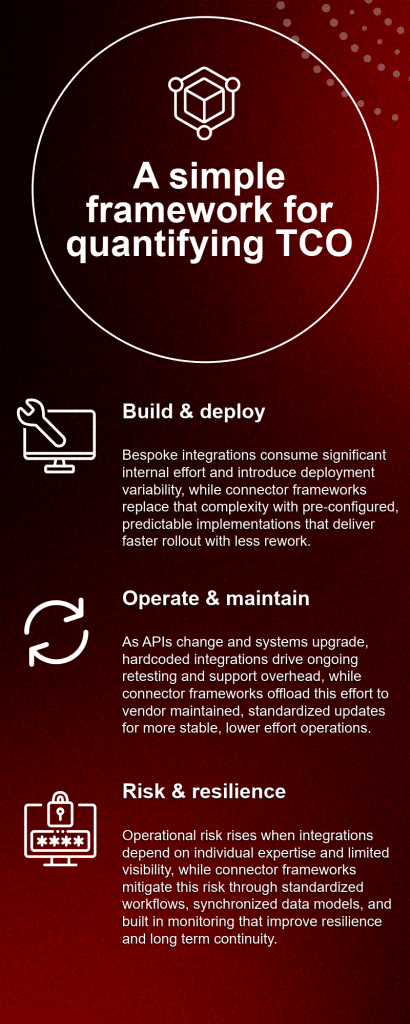
Tip: Assign probabilities and time costs to plausible failure modes (token expiry, schema change, throttling). Even conservative estimates typically show connector frameworks paying back in reduced support hours and fewer incident minutes.
From Integration Projects to Integration Strategy
Integration decisions should be evaluated not as onetime projects but as long term operational commitments that extend well beyond the initial build. While bespoke solutions can provide short term flexibility, they frequently introduce hidden costs, fragility, and operational risk that compound as environments evolve. Connector frameworks take a more sustainable approach by emphasizing maintainability, security, and scalability from the outset. For enterprise architects and IT operations leaders, moving past ad hoc integrations and relying on supported, configurable frameworks turn integration into a durable capability, reducing TCO while strengthening the resilience and long term credibility of the DCIM ecosystem.
Explore Nlyte’s out of the box connectors to see how supported, scalable integrations can reduce long term maintenance costs and strengthen your DCIM ecosystem by visiting our Connectors page.